


How to Build a VSCode Extension for Barcode and QR Code Development
Dynamsoft Barcode Reader, as an enterprise-class barcode and QR code SDK, supports many platforms (Windows, Linux, macOS, Android, iOS, Raspberry Pi OS, and Web) and programming languages (Python, Java, Swift, C#, Cpp, and JavaScript). There are many sample projects distributed in Dynamsoft GitHub repositories and official website. To help developers get started with Dynamsoft Barcode Reader quickly, we created a VSCode extension that features project generation for different programming languages and frameworks, code snippet insertion, and template download.
What you’ll build: A Visual Studio Code extension that generates barcode/QR code projects in multiple languages, inserts SDK code snippets, and downloads pre-configured parameter templates — all from the VS Code Command Palette.
Key Takeaways
- A single VSCode extension can scaffold barcode-scanning projects for .NET, C++, Python, Android, iOS, and Web from ready-made templates.
- Dynamsoft Barcode Reader code snippets can be registered per language so developers type a short prefix and get a working SDK call instantly.
- Parameter template files (Speed, Balanced, Coverage) are downloadable directly inside VS Code using the built-in
httpsmodule with progress notification. - The extension architecture — commands in
package.json, handlers inextension.ts, resources underres/— follows the standard VS Code extension pattern and is easy to fork.
Common Developer Questions
How do I create a VSCode extension that generates barcode scanning projects?
Start with the standard VS Code extension scaffold from yo code, then register project-generation commands in package.json and implement their handlers in extension.ts. That pattern lets one extension generate starter projects for multiple languages and frameworks from the Command Palette.
How do I add Dynamsoft Barcode Reader code snippets to VS Code?
Define snippet files per target language and contribute them through the extension manifest so developers can insert working SDK calls with short prefixes. The article treats snippets as a first-class feature alongside project generation and template downloads.
How do I download barcode parameter templates from a VSCode extension?
Use a VS Code command that fetches the template file over HTTPS, shows progress in the editor UI, and writes the downloaded file into the user’s workspace. That makes presets such as Speed, Balanced, or Coverage available without sending developers to an external download page.
This article is Part 1 in a 2-Part Series.
Prerequisites
- Node.js 14 or later
- Visual Studio Code 1.60 or later
- Yeoman and VS Code Extension Generator
- Get a 30-day free trial license for Dynamsoft Barcode Reader
Install the Dynamsoft Barcode Reader VSCode Extension
https://marketplace.visualstudio.com/items?itemName=Dynamsoft.dynamsoft-barcode-reader
Create Your First VSCode Extension
Let’s follow the official tutorial to create a basic VSCode extension project:
-
Install Yeoman and VS Code Extension Generator:
npm install -g yo generator-code -
Run the following command to scaffold a TypeScript or JavaScript project:
yo code -
Press
F5to debug the project and then pressF1to show theCommand Palette. We can enterHello Worldcommand to see the result.
Build the Barcode Reader Extension Features
The extension will support:
-
Project generation
Create console, desktop GUI, web and mobile apps.
-
Code snippet insertion
Add code snippets into corresponding programing language files.
-
File download
Download pre-set parameter template files for barcode and QR code recognition.
Generate a Barcode Reader Project
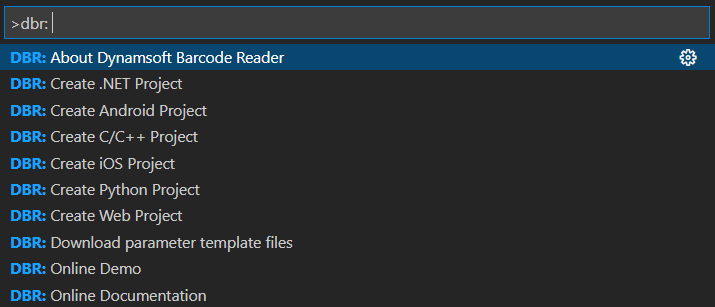
Step 1: Define Commands for the Command Palette
In package.json file, the commands for project generation are defined as follows:
"activationEvents": [
    "onCommand:dbr.dotnet",
    "onCommand:dbr.cpp",
    "onCommand:dbr.web",
    "onCommand:dbr.python",
    "onCommand:dbr.android",
    "onCommand:dbr.ios"
  ],
"contributes": {
    "commands": [
      {
        "command": "dbr.dotnet",
        "title": "DBR: Create .NET Project"
      },
      {
        "command": "dbr.cpp",
        "title": "DBR: Create C/C++ Project"
      },
      {
        "command": "dbr.web",
        "title": "DBR: Create Web Project"
      },
      {
        "command": "dbr.python",
        "title": "DBR: Create Python Project"
      },
      {
        "command": "dbr.android",
        "title": "DBR: Create Android Project"
      },
      {
        "command": "dbr.ios",
        "title": "DBR: Create iOS Project"
      }
    ],
  },
To make the commands work, we need to add the following TypeScript code to extension.ts file:
export function activate(context: vscode.ExtensionContext) {

	context.subscriptions.push(...[
		vscode.commands.registerCommand('dbr.dotnet', async () => {
		}),
		vscode.commands.registerCommand('dbr.cpp', async () => {
		}),
		vscode.commands.registerCommand('dbr.web', async () => {
		}),
		vscode.commands.registerCommand('dbr.python', async () => {
		}),
		vscode.commands.registerCommand('dbr.android', async () => {
		}),
		vscode.commands.registerCommand('dbr.ios', async () => {
		})
	]);
}
Step 2: Prepare the Project Templates
We put some project templates under the res folder and store their physical paths in TypeScript:
private samples = {
        "python": path.join(__dirname, '../res/python/'),
        "dotnet": path.join(__dirname, '../res/dotnet/'),
        "cpp": path.join(__dirname, '../res/cpp/'),
        "web": path.join(__dirname, '../res/web/'),
        "android": path.join(__dirname, '../res/android/'),
        "ios": path.join(__dirname, '../res/ios/')
    };
According to the input command, we can return the corresponding project path:
enum Type {
    CONSOLE = 'Console App',
    WINFORMS = 'Windows Forms App',
    FILE = 'File Reader',
    CAMERA = 'Camera Scanner',
    GUI = 'GUI App',
}

enum FolderName {
    FOLDER_NAME_CONSOLE = 'console',
    FOLDER_NAME_WINFORMS = 'winforms',
    FOLDER_NAME_FILE = 'file',
    FOLDER_NAME_CAMERA = 'camera',
    FOLDER_NAME_GUI = 'gui',
}

switch (option) {
    case "dotnet":
        root = this.samples.dotnet;
        projectType = await this.getProjectType([Type.CONSOLE, Type.WINFORMS]);
        break;
    case "cpp":
        root = this.samples.cpp;
        projectType = await this.getProjectType([Type.CONSOLE]);
        break;
    case "web":
        root = this.samples.web;
        projectType = await this.getProjectType([Type.FILE, Type.CAMERA]);
        break;
    case "python":
        root = this.samples.python;
        projectType = await this.getProjectType([Type.CONSOLE, Type.GUI]);
        break;
    case "android":
        root = this.samples.android;
        projectType = await this.getProjectType([Type.CAMERA]);
        break;
    case "ios":
        root = this.samples.ios;
        projectType = await this.getProjectType([Type.CAMERA]);
        break;
}
if (projectType === '') { return; }

switch (projectType) {
    case Type.CONSOLE:
        src = path.join(root, FolderName.FOLDER_NAME_CONSOLE);
        break;
    case Type.WINFORMS:
        src = path.join(root, FolderName.FOLDER_NAME_WINFORMS);
        break;
    case Type.FILE:
        src = path.join(root, FolderName.FOLDER_NAME_FILE);
        break;
    case Type.CAMERA:
        src = path.join(root, FolderName.FOLDER_NAME_CAMERA);
        break;
    case Type.GUI:
        src = path.join(root, FolderName.FOLDER_NAME_GUI);
        break;
}
Step 3: Select and Open the Target Project Folder
When creating a new project, we call vscode.window.showQuickPick to list two options: using current workspace folder or opening a new folder.
const answer = await vscode.window.showQuickPick(['Yes', 'No'], { placeHolder: 'Do you want to create a new folder?' });
        if (!answer) { return; }
If the answer is Yes, we call vscode.window.showOpenDialog to pop up a window for opening a folder:
const projectName = await vscode.window.showInputBox({
            prompt: 'Enter a name for the new project',
            validateInput: (value: string): string => {
                if (!value.length) {
                    return 'A project name is required';
                }
                return '';
            }
        });

let workspace = '';
const folderUris = await vscode.window.showOpenDialog({ canSelectFolders: true, canSelectFiles: false, canSelectMany: false, openLabel: 'Select folder' });
if (!folderUris) {
    return '';
}

let workspaceFolderUri = folderUris[0];
workspace = workspaceFolderUri.fsPath;
let des = path.join(workspace, projectName);
If the answer is No, we use the current workspace folder:
let folders = vscode.workspace.workspaceFolders;
let des = folders[0].uri.fsPath;
Step 4: Copy Project Files to the Target Folder
Once the target folder is determined, we can copy the project template files to the target folder:
export function copyFolder(src: string, des: string) {
	fs.readdir(src, (err, files) => {
		if (err) {
			return;
		}

		files.forEach(file => {
			let srcFile = path.join(src, file);
			let desFile = path.join(des, file);
			if (fs.statSync(srcFile).isDirectory()) {
				fs.mkdirSync(desFile);
				copyFolder(srcFile, desFile);
			} else {
				fs.copyFileSync(srcFile, desFile);
			}
		});
	});
}

copyFolder(src, des);
Add Code Snippet Support
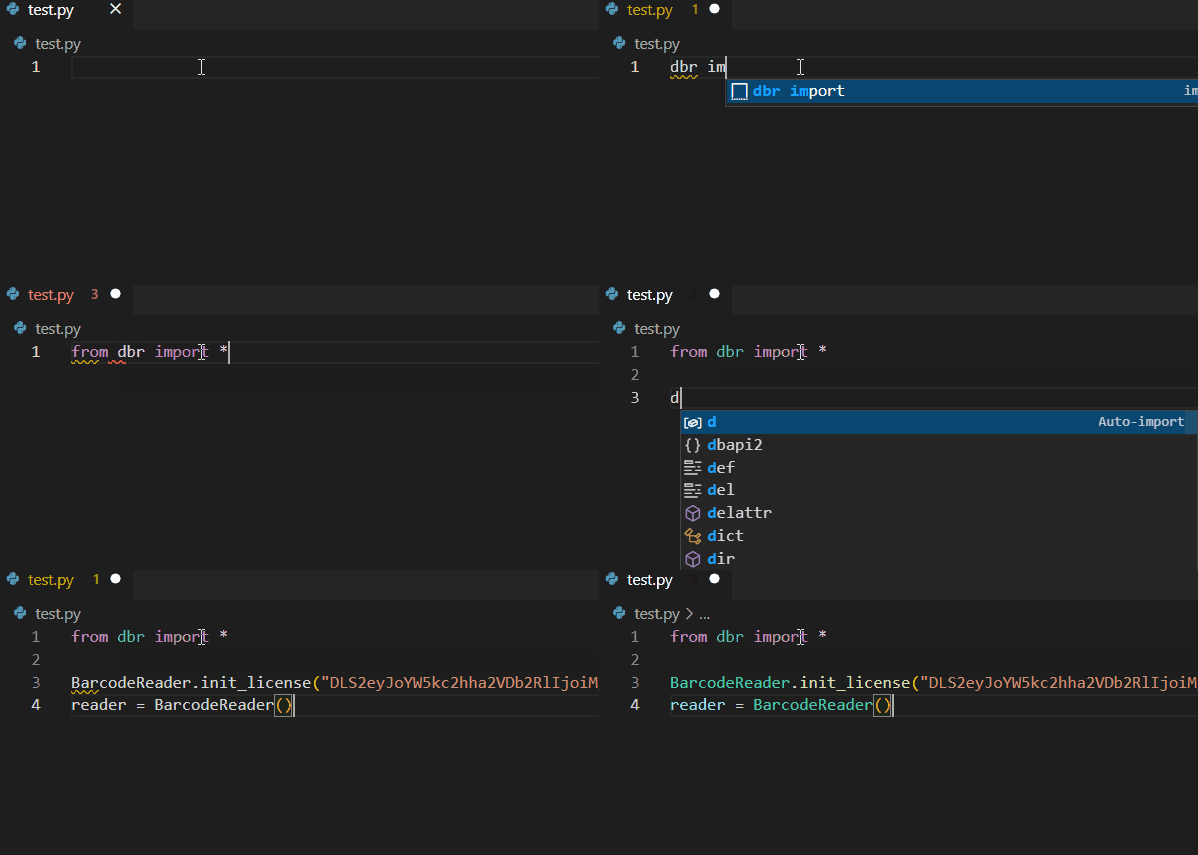
The structure of the snippet files are as follows:
{
    "prefix": "",
    "body": "",
    "description": ""
}
Create a folder named snippets and add some snippet files:
snippets
 - android.json
 - cpp.json
 - csharp.json
 - python.json
 - swift.jon
 - web.json
After that, open package.json to add the snippet file paths:
"contributes": {
    "snippets": [
			{
				"language": "python",
				"path": "./snippets/python.json"
			},
      {
				"language": "csharp",
				"path": "./snippets/csharp.json"
			},
      {
				"language": "html",
				"path": "./snippets/web.json"
			},
      {
				"language": "cpp",
				"path": "./snippets/cpp.json"
			},
      {
				"language": "java",
				"path": "./snippets/android.json"
			},
      {
				"language": "swift",
				"path": "./snippets/swift.json"
			}
		]
}
As long as the extension is installed in Visual Studio Code, we can quickly add code snippet in corresponding language files to expedite the development process.
Download Parameter Template Files
To download files from specified URLs in VSCode extension, we invoke http or https module. The vscode.window.withProgress is used to visually show the progress status.
import * as https from 'https';

export async function httpsDownload(url: string, filename: string) {
	await vscode.window.withProgress({
		location: vscode.ProgressLocation.Notification,
		cancellable: true
	}, (progress, token) => {
		token.onCancellationRequested(() => {
			console.log("User canceled the long running operation");
		});

		progress.report({ message: "Downloading " + filename });

		return new Promise((resolve, reject) => {
			const file = fs.createWriteStream(filename);
			https.get(url, function (response: any) {
				response.pipe(file);
				file.on("finish", () => {
					file.close();
					console.log("Download Completed");
					resolve("Download Completed");
				});
			});

		});
	});
}
We call the function defined above to download parameter template files of Dynamsoft Barcode Reader:
import * as vscode from 'vscode';
import { httpsDownload } from './utils';
import * as path from 'path';

enum Template {
    URL = "https://raw.githubusercontent.com/yushulx/cmake-cpp-barcode-qrcode/main/templates/",
    SPEED = 'Speed',
    SPEED_FILE = 'speed.json',
    BALANCED = 'Balanced',
    BALANCED_FILE = 'balanced.json',
    COVERAGE = 'Coverage',
    COVERAGE_FILE = 'coverage.json',
    MORECOVERAGE = 'More Coverage',
    MORECOVERAGE_FILE = 'morecoverage.json',
    MOSTCOVERAGE = 'Most Coverage',
    MOSTCOVERAGE_FILE = 'mostcoverage.json',
}

export class ParameterManager {
    private templates: any = {};

    constructor() {
        this.templates[Template.SPEED] = Template.URL + Template.SPEED_FILE;
        this.templates[Template.BALANCED] = Template.URL + Template.BALANCED_FILE;
        this.templates[Template.COVERAGE] = Template.URL + Template.COVERAGE_FILE;
        this.templates[Template.MORECOVERAGE] = Template.URL + Template.MORECOVERAGE_FILE;
        this.templates[Template.MOSTCOVERAGE] = Template.URL + Template.MOSTCOVERAGE_FILE;
    }

    public async downloadParameterFile() {
        // Select a template file
        const answer = await vscode.window.showQuickPick([Template.SPEED, Template.BALANCED, Template.COVERAGE, Template.MORECOVERAGE, Template.MOSTCOVERAGE], { placeHolder: 'Select a template' });
        if (!answer) { return; }

        let folders = vscode.workspace.workspaceFolders;
        if (!folders) {
            vscode.window.showWarningMessage('No folder is opened.');
        }
        else {
            let des = folders[0].uri.fsPath;
            switch (answer) {
                case Template.SPEED:
                    httpsDownload(this.templates[Template.SPEED], path.join(des, Template.SPEED_FILE));
                    break;
                case Template.BALANCED:
                    httpsDownload(this.templates[Template.BALANCED], path.join(des, Template.BALANCED_FILE));
                    break;
                case Template.COVERAGE:
                    httpsDownload(this.templates[Template.COVERAGE], path.join(des, Template.COVERAGE_FILE));
                    break;
                case Template.MORECOVERAGE:
                    httpsDownload(this.templates[Template.MORECOVERAGE], path.join(des, Template.MORECOVERAGE_FILE));
                    break;
                case Template.MOSTCOVERAGE:
                    httpsDownload(this.templates[Template.MOSTCOVERAGE], path.join(des, Template.MOSTCOVERAGE_FILE));
                    break;
            }
        }
    }
}
Common Issues and Edge Cases
- Extension activation fails silently: If the commands do not appear in the Command Palette after installation, verify that every command string in
package.jsonunderactivationEventsexactly matches the corresponding entry undercontributes.commands. A single typo will prevent VS Code from registering the command. - Project template folder not found: The
path.join(__dirname, '../res/...')paths are resolved relative to the compiled JavaScript output, not the TypeScript source. After changing theres/folder structure, run a clean build and confirm the files are copied into theout/directory. - HTTPS download hangs behind a corporate proxy: The built-in
https.getdoes not respect VS Code’s proxy settings automatically. If downloads stall, readvscode.workspace.getConfiguration('http').get('proxy')and pass it as an agent option tohttps.get.