


Build a Web App to Chat with Scanned Documents Using ChatGPT and LangChain
Large language models (LLMs) are emerging which can help us in tasks like text summarization, translation, question answering, etc and OpenAI’s ChatGPT is one of the state-of-art models which is available via its web or API interfaces.
ChatGPT can be useful for document management. One use case of it is to answer questions with the document providing the background knowledge.
In the previous article, we’ve built a web application to scan documents and run OCR with Dynamic Web TWAIN and Tesseract.js. In this article, we are going to add the ability to chat with scanned documents to it.
What you’ll build: A JavaScript web application that scans physical documents, extracts text via OCR, and lets you ask natural-language questions about the content using the ChatGPT API and LangChain.
Key Takeaways
- LangChain’s vector store lets ChatGPT answer questions grounded in your scanned document text, reducing hallucination.
- Dynamic Web TWAIN handles scanner hardware integration in the browser; Tesseract.js performs client-side OCR on the scanned images.
- Splitting OCR text into chunks with
RecursiveCharacterTextSplitterand embedding them via OpenAI produces a searchable knowledge base for Q&A. - This approach works for any text-heavy scanned document — release notes, legal contracts, news articles — where you need targeted answers rather than manual reading.
Common Developer Questions
How do I use ChatGPT to answer questions about scanned documents in a web app?
Scan the document, run OCR to extract the text, turn that OCR output into retrievable chunks, and then send the user’s question plus the most relevant chunks to the LLM. In this article, Dynamic Web TWAIN handles acquisition, Tesseract.js handles OCR, and LangChain plus ChatGPT handle the Q&A layer.
How do I create a vector store from OCR text using LangChain and OpenAI embeddings in JavaScript?
Split the OCR text into manageable chunks with RecursiveCharacterTextSplitter, generate embeddings for those chunks, and store them in a MemoryVectorStore or another LangChain-compatible vector store. That searchable document memory is what the app uses to retrieve relevant context before calling ChatGPT.
Why does ChatGPT hallucinate answers without document context, and how does RAG fix it?
Without document context, the model falls back to its general training knowledge and may invent details that are not present in the scanned file. Retrieval-augmented generation reduces that risk by injecting the most relevant OCR-derived passages into the question-answering step.
Prerequisites
- Node.js installed
- An OpenAI API key (for embeddings and ChatGPT)
- A working document scanning + OCR setup from the previous tutorial
- Get a 30-day free trial license for Dynamic Web TWAIN
Build a ChatGPT-Powered Document Q&A with LangChain
LangChain is a library aiming to assist in calling LLMs. We can use it to let ChatGPT answer questions with scanned documents providing extra knowledge. Here are the steps to use it in a web application:
Step 1: Install LangChain
npm install langchain
Step 2: Create a Vector Store from Scanned Document Text
A Vector Store stores memories in a VectorDB and queries the top-K most “salient” docs every time it is called. It can be used to provide related background knowledge for a chat.
-
Create an OpenAI embeddings model.
// Create the models const embeddings = new OpenAIEmbeddings({openAIApiKey: apikey}); -
Use
RecursiveCharacterTextSplitterto split the text into split documents.const splitter = new RecursiveCharacterTextSplitter({ chunkSize: 4000, chunkOverlap: 200, }); const docs = await splitter.createDocuments([text]); -
Create a Vector Store using the split documents and the embeddings model.
const store = await MemoryVectorStore.fromDocuments(docs, embeddings);
Step 3: Start a QA Chain to Answer Questions over Documents
-
Create a new OpenAI model.
const model = new OpenAI({openAIApiKey: apikey, temperature: 0 }); -
Create a new QA chain.
const chain = loadQARefineChain(model); -
Select the documents related to the question from the Vector Store.
const relevantDocs = await store.similaritySearch(question); -
Call the chain to answer the question over the selected documents.
// Call the chain
const res = await chain.call({
  input_documents: relevantDocs,
  question,
});
Test the Results with Real Documents
Next, let’s test if it works well. Here, we test two example documents.
Example 1 - Release Notes of Dynamic Web TWAIN
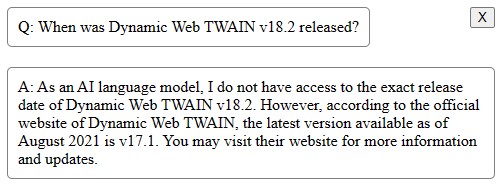
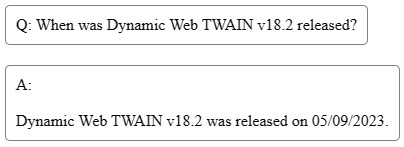
Suppose we would like to know when the v18.2 version of Dynamic Web TWAIN was released.
If we don’t use the document as the background knowledge, it will produce the following answer:
After using the document, it can correctly answer the question:
Example 2 - BBC News about World Snooker Championship
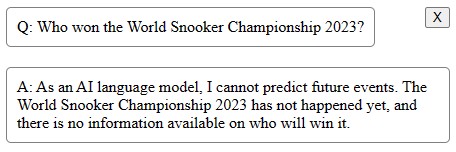
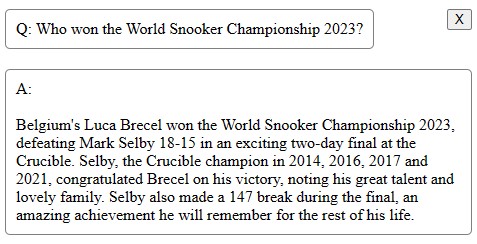
Suppose we would like to know who won the World Snooker Championship 2023.
If we don’t use the news as the background knowledge, it will produce the following answer:
After using the news, it can correctly answer the question:
Known Limitations
ChatGPT sometimes makes up things which are not true. Providing relevant document context via the vector store reduces but does not eliminate hallucination.
Common Issues and Edge Cases
- OCR quality affects answers: If the scanned image is skewed, blurry, or low-resolution, Tesseract.js may produce garbled text. Pre-process scans (deskew, crop, adjust contrast) before running OCR to improve ChatGPT’s answer accuracy.
- Token limit exceeded on large documents: Long documents may produce chunks that exceed the OpenAI model’s context window. Reduce
chunkSizeinRecursiveCharacterTextSplitter(e.g., from 4000 to 2000) and increasechunkOverlapto ensure no content is lost. - API key exposed in client-side code: Never ship your OpenAI API key in production front-end code. Use a backend proxy or serverless function to forward requests to the OpenAI API securely.
Source Code
Checkout the source code of the demo to have a try: Get the complete sample project source code on GitHub