


 Blog
Blog
Which Dynamsoft Barcode SDK License Should You Choose? A Simple Guide
Choosing the right barcode SDK license shouldn’t be complicated. Dynamsoft’s Web Barcode Reader SDK offers six licensing models designed to match how your application is built, deployed, and scaled — from small web apps to large enterprise systems. This guide explains how each model works, what it counts, and which scenarios it fits — so you can choose the right one before you buy.
Before You Buy: Key Takeaways Worth Knowing
- Free 30-day trial is available — no credit card required
- Six license models cover everything from low-volume pay-as-you-go apps to high-throughput server farms
- Licensing supports both online and offline operation, making it suitable for restricted or field environments.
- Built-in deduplication reduces unnecessary license usage in high-frequency scanning scenarios.
- Most teams can select the right license model based on how their app is deployed and scaled, not just technical features.
- Framework-ready with official GitHub samples for React, Angular, Vue, and Svelte
- Enterprise-Ready Support: Dynamsoft provides global support, pre-sales assistance, and a dedicated technical documentation portal.
How Dynamsoft Licensing Works
What Are the Six Dynamsoft License Types?
Select the license model that is cost-efficient and compliant for production. Dynamsoft offers six types through its License Server (DLS):
| License Type | Best For | Counts |
|---|---|---|
| Per Barcode Scan | Low-volume or pay-as-you-go apps | Unique successful decodes |
| Per Client Device | Fixed user base; offline environments | Authorized active devices |
| Per Concurrent Device | Apps with fluctuating concurrent users | Max active devices per 3-min window |
| Per Domain | SaaS on a single domain | Unlimited usage under one domain |
| Per Server | Backend/server-side processing | Active servers with SDK loaded in RAM |
| Per Concurrent Instance | High-throughput server farms, cloud | Max reader instances per 3-min window |
Choosing the Right License: A Quick Reference
| I need to… | Best license |
|---|---|
| Pay only for scans I actually use | Per Barcode Scan |
| Support scanning in offline environments | Per Client Device |
| License a large user base that doesn’t all scan simultaneously | Per Concurrent Device |
| Cover all users on a single SaaS domain, no counting | Per Domain |
| Run server-side scanning on a fixed number of servers | Per Server |
| Scale server-side scanning across a distributed cloud fleet | Per Concurrent Instance |
If none of the standard models fit your deployment, such as OEM distribution or volume-based global licensing, contact the Dynamsoft sales team to discuss a custom solution.
Confirm Your Requirements
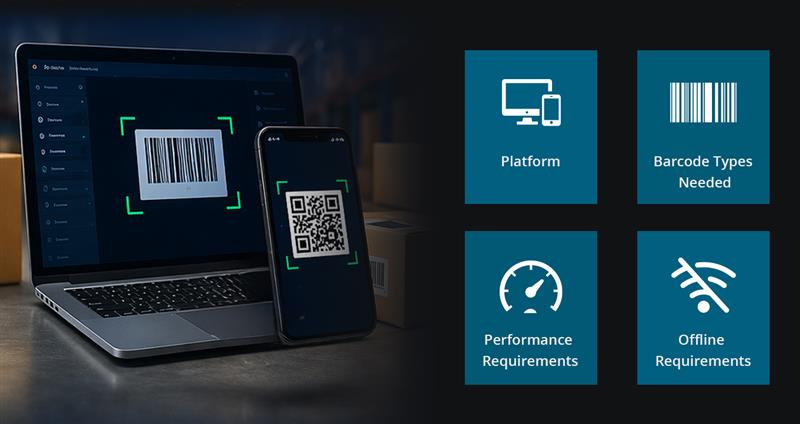
Defining your requirements early helps you choose the right SDK features and licensing model, reducing the risk of costly changes later. Consider the following:
- Platform: Will your app run in a standard browser, as a Progressive Web App (PWA), or in a hybrid environment such as Electron?
- Barcode Types Needed:
- 1D: Code 128, Code 39, EAN, UPC, ITF
- 2D: QR Code, Data Matrix, PDF417, Aztec
- Performance Requirements: Specify required scans per minute, acceptable latency, and barcode conditions to support, including curved, wrinkled, or Direct Part Mark (DPM) barcodes.
- Offline requirements: For users in warehouses, field environments, or restricted networks, offline mode is a key feature of the Per Client Device license.
Offline Mode: A Critical Capability for Enterprise Deployments
For teams in environments with unreliable or restricted internet connectivity, offline mode is essential.
“The device stores a local license which makes sure the device can work online or offline as long as it is active.” — Dynamsoft License Server Documentation.
With the Per Client Device license, each authorized device receives a locally cached license file upon authorization. The process is as follows:
- The device’s UUID is registered with the Dynamsoft License Server (DLS) and occupies a license seat.
- The local license is valid for the full active period: 24 hours, 30 days, 90 days, or 365 days, depending on the tier purchased.
- The active period refreshes automatically each time the device reconnects to DLS to reauthorize or submit a usage report.
- If the device remains idle or offline beyond its active period, it stops working, and DLS releases its seat for a new device, ensuring you never pay for unused capacity.
This capability makes the Dynamsoft SDK well-suit 5r5 ed for warehouse workers, field technicians, healthcare facilities, and secure or air-gapped environments, without the need for custom workarounds.
Ready to Get Started? Connect with the Dynamsoft Team
Purchasing the Dynamsoft Web Barcode SDK is straightforward when you follow these steps: define your requirements, validate with a free trial, select the appropriate license model, integrate, and deploy.
The six license models address scenarios from small single-domain web applications to distributed server farms processing millions of scans daily. Offline mode in the Per Client Device license ensures full support for teams in connectivity-constrained environments, without workarounds or compromises.
Start your 30-day free trial to see why thousands of developers worldwide trust Dynamsoft for mission-critical barcode scanning.
Frequently Asked Questions
Below are answers to common questions frequently asked by developers and IT decision-makers before purchasing.
1. How do I get a free trial license key?
Sign up at dynamsoft.com/customer/license/trialLicense to request a free 30-day trial key. Once issued, activate it in your application using LicenseManager.initLicense(…). No credit card is required.
2. What are the technical prerequisites for using the SDK?
For modern web applications, you will need Node.js 18 or later and npm 9 or later, or the appropriate dependencies for your framework. The SDK can be loaded via CDN, installed via npm, or self-hosted, depending on your infrastructure.
3. Can the SDK operate in offline mode?
Yes. Under the Per Client Device license, each device stores a local license upon authorization. The device can scan barcodes offline for the duration of its active period (24 hours to 365 days). The period refreshes automatically when the device reconnects to DLS. If the device remains offline beyond its active period, it stops working, and the license seat is released for another device.
4. What happens when my trial license expires?
The SDK will stop functioning until a paid production key is activated. Your integration code does not change; only the license key value needs to be updated.
5. Which license model is best for a large SaaS web application?
The per-application license is usually the best fit. It allows unlimited SDK usage for all users and features within a single application. This makes it a simple and scalable option for high-traffic SaaS platforms, regardless of how many domains or subdomains are used to access the application.
If you’re unsure which licensing model best fits your architecture, you can contact Dynamsoft support. They will help you evaluate your use case and recommend the most suitable option.
6. How are barcode scans counted under the Per Barcode Scan license?
Only unique, successful decodes are counted. The deduplication logic ensures that the same barcode appearing in multiple consecutive video frames within a 3-second window is counted only once. You can further narrow consumption by filtering barcode format, confidence level, or scanning region.
7. Can I use the SDK across multiple servers for high-volume processing?
Yes. The Per Concurrent Instance license is designed for server farms and cloud-scale deployments. Each server issues its own license request, and Dynamsoft License Server includes an overuse tolerance mechanism to handle peak-hour traffic across a distributed infrastructure.
8. How do I get a custom quote or enterprise pricing?
Contact the Dynamsoft sales team at sales@dynamsoft.com or schedule a meeting at dynamsoft.com. Dynamsoft offers volume pricing, OEM agreements, and partner arrangements for ISVs and resellers.