


 Blog
Blog
Why Barcode Scanning Fails at Scale (and How to Fix It)
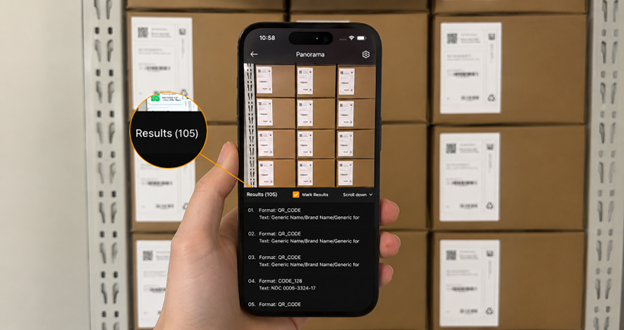
Engineering teams often see seamless prototype demos with instant barcode recognition and sub-200-millisecond decoding times. However, once deployed at scale, support issues typically emerge within months.
Scans that work reliably in controlled environments may fail in production. Latency spikes often occur during peak periods. A device model comprising 3% of the fleet can generate 40% of errors. Systems that manage 100 scans daily may struggle at 50,000, often without a clear root cause.
These issues signal the ‘scaling cliff,’ where initial success meets the complexities of enterprise-level deployment.
Key Takeaways: Why Barcode Scanning Breaks at Scale
- Real-world conditions reduce accuracy: Production factors such as harsh lighting, damaged labels, and motion blur significantly reduce decode accuracy compared to controlled testing.
- Latency is an end-to-end metric: True scan speed depends on camera initialization, network transit, and backend processing, not just algorithmic decode time.
- Error handling is essential: System architecture should include automated error handling, user feedback, and OCR fallbacks to prevent bottlenecks.
- Device fragmentation causes inconsistency: Software must dynamically adjust to different camera APIs and optical capabilities across hardware models.
- Decoupled backends prevent bottlenecks: Asynchronous processing and local caching are necessary to manage peak loads without freezing mobile clients.
Why Controlled Testing Fails for Enterprise Barcode Scanning
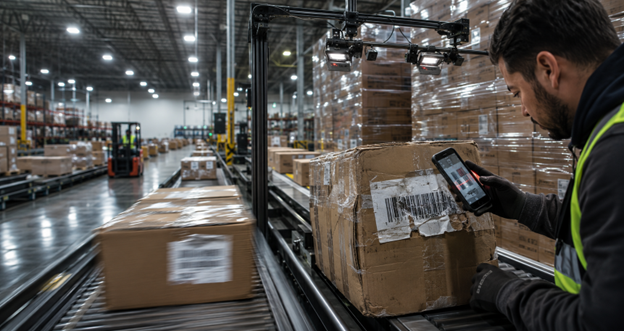
Transitioning from laboratory settings to high-volume environments reveals the limitations of early-stage prototypes.
Barcode scanning solutions are often developed under ideal conditions, such as optimal lighting, undamaged labels, and a single high-end device. These environments overlook edge cases, as clean barcodes decode quickly. Scaling introduces far greater physical and environmental complexity.
At 1 million scans per day in logistics, retail, or healthcare, systems must handle highly variable conditions:
- Labels that have been torn, wrinkled, or soaked on a rainy loading dock.
- Workers scanning at extreme angles or just 4 inches away from a dense barcode instead of the optimal 12 inches.
- Fast-moving conveyor belts that introduce severe motion blur.
- Direct Part Marking (DPM) engraved on reflective metallic surfaces.
In these conditions, a ‘99% decode accuracy’ in testing often drops to about 91% in production. At 1 million scans, this 8% drop results in 90,000 failures daily, causing labor inefficiencies and supply chain risks.
Prototype Expectations vs. Production Realities
| Variable | Prototype Environment | Production Environment |
|---|---|---|
| Lighting | Consistent, bright, diffuse overhead | Dim corners, harsh glare, dynamic shadows |
| Label Quality | Pristine, high-contrast, flat | Damaged, faded, curved, plastic-wrapped |
| Motion | Static positioning | High-speed movement, hand-shake blur |
| Hardware | Latest flagship device | Mixed fleet (budget Android, legacy kiosks) |
Common Points of Failure in High-Volume Scanning Systems
As transaction volumes increase, minor inefficiencies in scanning architecture can escalate into significant operational challenges.
How End-to-End Latency Impacts Barcode Scanning Throughput
In high-throughput environments, focusing solely on algorithm decode time provides an incomplete, overly optimistic view of the user experience.
Actual scan latency is the total round-trip time for the entire workflow. Heavy reliance on cloud validation can create bottlenecks during peak API loads. A scanner with a 180-millisecond decode algorithm may experience an end-to-end process time of 1.4 seconds in production.
Anatomy of a 1.4-Second Scan Delay
| Process Step | Description | Typical Time Cost |
|---|---|---|
| Camera Initialization | Waking the hardware and adjusting focus/exposure | ~250 ms |
| Image Preprocessing | Grayscale conversion, noise reduction, binarization | ~50 ms |
| Barcode Decoding | Algorithmic detection and extraction of the payload | ~180 ms |
| Network Transit | Sending payload to the cloud and awaiting routing | ~400 ms |
| Backend Processing | Database write, ERP sync, and validation response | ~520 ms |
| Total Latency | End-to-End User Wait Time | ~1.4 Seconds |
Latency has a significant cumulative cost. At 800 scans per shift, a 1.2-second delay per scan results in 16 minutes of lost productivity per worker each day. For 50 workers, this equals one full-time equivalent lost to digital friction. Processing should be moved to the edge with on-device decoding and local cache validation to reduce network delays.
Learn more about overcoming these performance challenges in our blog on Boosting Barcode Reading Speed.
How do you improve barcode scanning performance at scale?
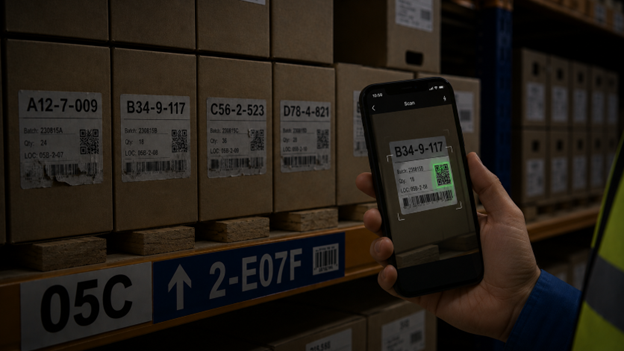
Thousands of scans fail daily due to environmental factors, robust error recovery workflows become as important as primary success paths.
At a small scale, failed scans are minor inconveniences. At scale, a 5% failure rate leads to systemic changes, with workers creating informal workarounds such as manual SKU entry, photographing barcodes for later, or bypassing validation steps.
Achieving a 100% first-pass decode rate in the field is not feasible. Instead, robust applications implement workflows to handle failures, such as automatic retries with adjusted camera settings, OCR fallbacks for damaged text, and clear UI feedback to distinguish error types.
How does hardware fragmentation affect barcode scanning?
Managing a mixed hardware fleet introduces unpredictable variables in optics, processing power, and operating system behavior, which must be addressed through software.
QA teams may test on a few flagship devices, but production fleets often include many models, from high-end iPhones to budget tablets and legacy scanners. Camera APIs vary significantly in how they handle autofocus, white balance, and lens switching.
At low volumes, an autofocus bug on a budget tablet is rare. At 1 million scans, an issue affecting 8% of devices results in 80,000 failed attempts before it is detected. Consistency requires adaptive scanning parameters based on device hardware profiles.
Why Backend Architecture is Critical for Scalable Barcode Processing
A mobile scanner’s efficiency depends on backend systems, making server-side architecture a common bottleneck at scale.
Each successful scan triggers downstream events such as inventory lookups, ERP updates, and compliance logging. When 200 workers scan simultaneously, systems can become strained by the sudden concurrency.
- Database Contention: Multiple scans attempting to update the same SKU record simultaneously can cause lock conflicts, manifesting as 3-second application freezes on the floor.
- API Rate Limiting: Saturated cloud services will drop or delay requests during volume spikes, severing the connection between the device and the data.
- Synchronous Chains: Forcing the mobile application to wait for every downstream microservice to confirm receipt before allowing the next scan will inevitably cripple throughput.
To address this, enterprise architectures should use asynchronous message queues, process scans locally, and synchronize payloads when backend traffic subsides.
The Importance of Observability in Enterprise Scanning Operations
Operating large-scale scanning deployments without visibility leads to prolonged outages. Granular telemetry is essential to detect issues before users are affected.
At a small scale, user complaints prompt debugging. At scale, waiting for user reports is insufficient. Enterprise systems need detailed instrumentation at every layer, tracking success rates by device, environment, symbology, and time. Without comprehensive observability, identifying the cause of performance drops is impossible.
Architectural Principles for Scaling Barcode Scanning Systems
High-volume barcode scanning requires proactive engineering, not reactive fixes. Successful engineering teams treat early prototypes as disposable and design production environments based on established, robust principles:
- Edge-First Architecture: Default to on-device decoding and local data caching, interacting with the network only when strictly necessary.
- Adversarial Metric Tracking: Measure decode robustness against motion blur, low light, and damaged labels as the primary KPI, not secondary edge cases.
- Data-Driven Error Handling: Instrument failure workflows so that user retries and manual overrides are logged as telemetry data.
- Hardware-Adaptive Parameters: Use software that automatically adjusts to the device’s specific camera capabilities rather than assuming ideal optical conditions.
- Asynchronous Backends: Implement decoupled, event-driven backend systems that absorb volume spikes without cascading latency to the mobile client.
How to Future-Proof Your Scanning Architecture with Dynamsoft
Transitioning from proof-of-concept to enterprise-grade scanning requires technology designed for real-world conditions.
The key benchmark for barcode scanning is not laboratory speed, but the percentage of first-attempt successes across diverse devices, harsh environments, and peak loads. This metric distinguishes enterprise solutions from basic open-source libraries.
The Dynamsoft Barcode Reader is designed for production environments. Its optimized, multi-threaded algorithms enable fast on-device processing, eliminating network latency. With support for all standard symbologies, advanced damage recovery, and cross-platform deployment, Dynamsoft enables seamless scaling from 100 to 1 million scans.
Ready to test your scanning architecture in real-world, production-grade conditions?
Explore Dynamsoft Barcode Reader Today
Contact our Technical Support Team to Discuss your Specific Use Case
FAQ: Barcode Scanning at Scale
What causes barcode scanning failures in production? Poor lighting, damaged labels, motion blur, and device limitations are the main causes.
How accurate is barcode scanning in real-world environments? Lab accuracy (~99%) often drops to 90–92% in production conditions.
How can barcode scanning latency be reduced? Use on-device decoding, reduce network calls, and implement local caching.
Why is hardware fragmentation a problem? Different devices have varying camera quality and APIs, leading to inconsistent results.
What is the best architecture for scalable barcode scanning? An edge-first, asynchronous architecture with local processing and decoupled backends.