


 Blog
Blog
Passport Photo Extraction: What It Is and Why It Matters for Digital Onboarding
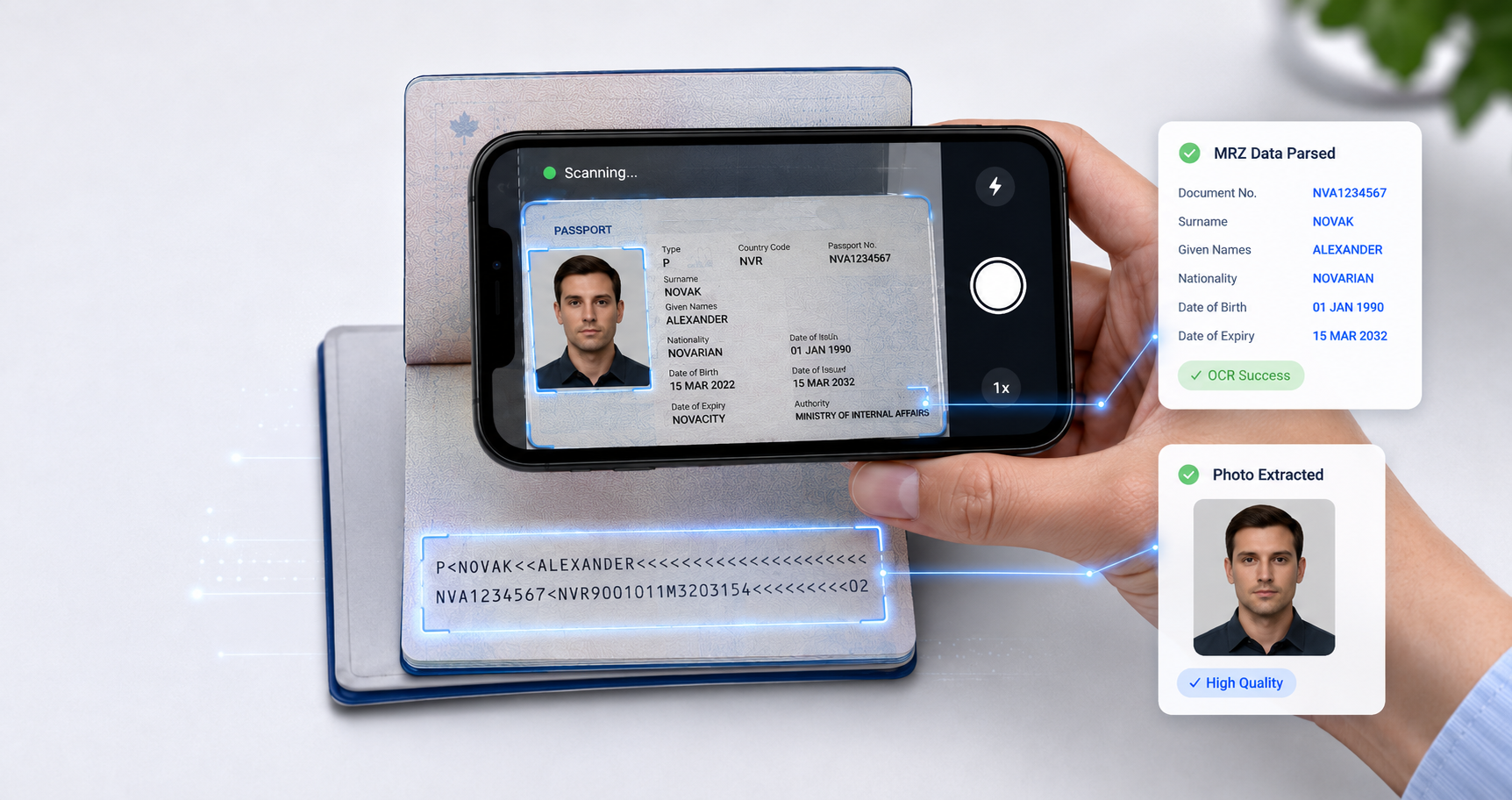
Digital onboarding has transformed how banks, fintechs, insurers, and other regulated businesses acquire customers. Opening an account, verifying identity, and completing compliance checks can now happen in minutes from a mobile phone. Yet despite these advances, passport verification remains one of the weakest points in many onboarding pipelines.
Most systems are designed to extract structured passport data such as the MRZ (Machine Readable Zone), but identity verification depends on more than text alone. The passport photo is equally critical because it connects the document to the person presenting it. Without reliable extraction of the facial image, onboarding workflows struggle to support accurate face matching, fraud detection, liveness verification, and automated KYC compliance.
Passport photo extraction fills this gap by automatically isolating and standardizing the holder’s portrait from a captured passport image. When combined with MRZ parsing, it enables onboarding systems to verify both the documented data and the visual identity in a single automated workflow.
The challenge, however, is that extracting both the MRZ data and the embedded photo reliably is far more difficult than it appears. Real-world captures include glare, blur, perspective distortion, shadows, holograms, partial occlusion, and inconsistent camera quality. Many onboarding systems can process either the MRZ or the photo with acceptable accuracy, but few handle both consistently enough to eliminate manual review.
This article explores why passport photo extraction has become a missing piece in digital onboarding and how combining facial image extraction with MRZ data processing enables faster, more reliable, and fully automated identity verification systems.
Key Takeaways
- Passport photo extraction is critical for digital onboarding - Automated onboarding requires both structured passport data and the holder’s facial image to support biometric matching and fraud detection.
- MRZ parsing + photo extraction enable a fully automated KYC workflow - covering form auto-fill, document authentication, selfie matching, and AML screening in a single pipeline.
- Manual review is a KYC liability, not just an operational cost - Inconsistent human checks create compliance gaps and audit trail weaknesses that regulators increasingly scrutinize.
- Real-world passport scanning is technically challenging - Systems must handle glare, blur, shadows, skewed angles, holograms, low-light images, and different passport layouts while accurately extracting both MRZ data and the portrait.
- Biometric verification significantly reduces fraud risk - Extracted passport portraits can be matched against live selfies to prevent stolen passport misuse, synthetic identity fraud, and photo substitution attacks.
What is the Gap in Today’s Digital Onboarding Workflows?
Although digital onboarding has advanced, identity verification remains a major operational challenge. Financial services, healthcare, telecommunications, and travel companies often require customers to upload or photograph passports for remote verification.
Many onboarding systems treat OCR, biometric verification, and fraud checks as separate workflows rather than a unified identity verification process.
Enterprises often rely on manual review of uploaded identity documents for three main reasons:
- General-purpose OCR has difficulty with passport layouts, security fonts, and low-quality mobile images.
- Many platforms store passport photos for compliance purposes, but do not use them for biometric verification.
- MRZ extraction is often inconsistent, making it difficult to reliably validate applicant data against the document.
As a result, onboarding workflows remain vulnerable to data entry errors, review delays, and increased fraud risk.
How Does Passport Photo Extraction Works in Practice?
Passport photo extraction automatically isolates the holder’s facial photograph from a passport image. Unlike basic OCR or image cropping, this process must address several challenges:
- Different passport layouts across issuing countries
- Mobile image quality issues such as glare, skew, blur, shadows, and low light
- Producing a clear, standardized facial image suitable for biometric comparison
The extracted portrait serves as the trusted reference image in biometric matching workflows.
Why MRZ Parsing and Passport Photo Extraction Work Better Together
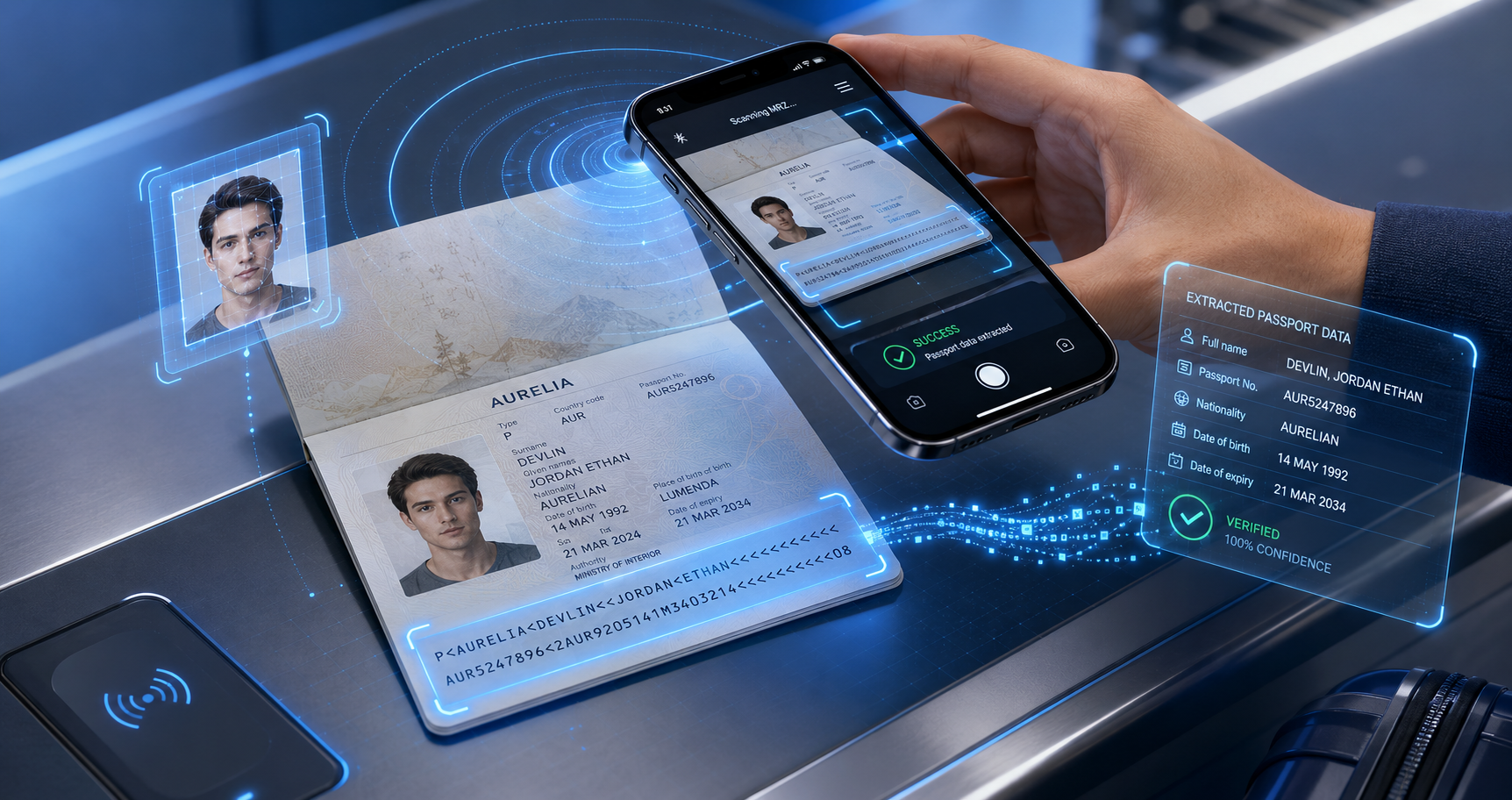
MRZ parsing and passport photo extraction each address distinct aspects of identity verification.
| Capability | Data extracted | Role in onboarding |
|---|---|---|
| MRZ parsing | Name, date of birth, nationality, document number, expiry, gender, check digits | Auto-fill onboarding forms, validate document authenticity, support AML and sanctions screening |
| Photo extraction | Normalized facial image from the passport data page | Biometric comparison against a live selfie and fraud detection reference |
MRZ parsing provides structured identity data, while portrait extraction supplies a biometric reference. Neither method is sufficient on its own.
Together, these capabilities enable onboarding systems to automatically read passports, verify authenticity, extract the holder’s facial image, and compare it to a live selfie, reducing manual intervention in standard cases.
How Automated Passport Verification Works End-to-End
Effective onboarding workflows use a dual-track pipeline for passport processing: one for structured identity data and one for biometric verification.
The applicant uploads or captures a photo of their passport.
The system:
- Detects and normalizes the passport image
- Identifies and parses the MRZ
- Validates MRZ check digits
- Extracts structured identity fields
- Isolates and normalizes the passport portrait
- Compares the extracted portrait against a live selfie capture
If both document validation and biometric comparison succeed, onboarding proceeds automatically without manual review.
Manual review is reserved for exceptions such as:
- Low-confidence reads
- Failed biometric matching
- Sanctions or AML alerts
- Suspicious document signals
This approach transforms onboarding from a basic OCR workflow into a comprehensive identity verification system.
Where Manual Processes Still Break Down
Even with digital onboarding, organizations face operational challenges if identity verification is not fully automated.
Data Entry Errors and Abandonment
Manual entry of passport details often leads to transcription errors. A single incorrect digit can delay onboarding, cause compliance issues, or result in rejection.
Automated MRZ extraction removes this risk by directly reading structured document data.
Manual Review Bottlenecks
Manual review queues slow onboarding and increase operational costs. Applicants expecting instant onboarding may wait hours or days for approval, increasing abandonment rates.
Biometric Verification Risk
The most significant verification gap occurs when onboarding systems capture passport images but do not compare the embedded portrait to the applicant’s selfie.
This creates opportunities for:
- Stolen passport misuse - a valid document used by someone other than the legitimate holder
- Photo substitution fraud - a physically altered document where the original portrait has been replaced
- Synthetic identity fraud - a fabricated identity combining real and fictitious document elements
Regulators now expect consistent identity verification workflows with robust audit trails.
Practical Use Cases Across Industries
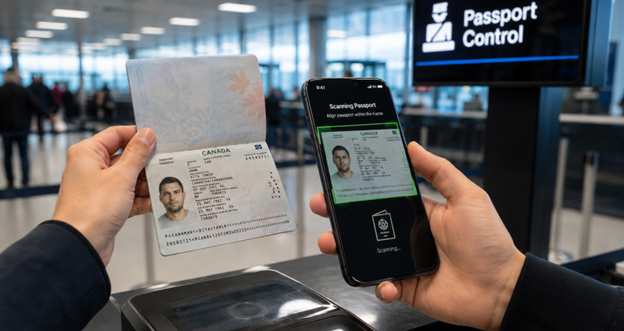
Financial Services and Fintech
Banks and digital lenders use automated passport processing to accelerate account opening, conduct remote customer due diligence at scale, and meet KYC obligations without increasing staff.
Travel and Hospitality
Airlines and hotel groups use passport processing during booking and check-in to streamline identity verification and reduce waiting times.
Healthcare
International hospitals and cross-border insurers rely on accurate passport capture for patient registration and verification.
Telecommunications
Mobile operators in regulated markets use automated passport verification for prepaid SIM registration and remote onboarding.
How Dynamsoft Solves the Passport Photo Extraction in Production
For teams modernizing digital onboarding, the challenge goes beyond capturing passport data. The key requirement is to combine document validation and biometric identity verification in a single workflow that operates reliably across mobile and web channels.
Dynamsoft’s MRZ Scanner SDK supports both structured data and passport portrait extraction within a single integration.
Key capabilities include:
MRZ and portrait extraction in one workflow
The SDK provides parsed MRZ fields, a cropped document image, and an automatically extracted passport portrait for biometric comparison.
High-accuracy MRZ recognition
The OCR engine combines neural network recognition, image processing, and MRZ validation logic to ensure high accuracy, even on low-quality mobile images.
Built-in image preprocessing
The SDK automatically detects document borders, corrects skew and perspective, crops the document region, and filters blurred frames during video capture.
Offline, on-device processing
All processing occurs locally on the user’s device, helping organizations meet GDPR, CCPA, and HIPAA compliance. Dynamsoft is also ISO 27001 certified.
Cross-platform support
The SDK supports JavaScript, Android, iOS, React Native, Flutter, MAUI, .NET, C++, and Python, enabling teams to maintain consistent onboarding workflows across all platforms.
Combining MRZ parsing and portrait extraction into a single SDK workflow reduces integration complexity and eliminates the need for multiple OCR and biometric preprocessing tools.
Production Results: First United Bank
First United Bank deployed Dynamsoft SDKs as part of a branch onboarding modernization across 108 locations and 350 bankers.
Account opening time dropped from 45 minutes to 10 minutes. Based on transaction volume, the bank projects approximately 3.5 years of staff time recovered from manual data entry — time redirected to customer engagement rather than document processing.
Take the Next Step Toward Automated Onboarding
For teams modernizing KYC and onboarding workflows, the priority is to select a document-processing SDK that reliably handles both structured identity data and biometric verification in a single integration - reducing vendor complexity and eliminating the MRZ-only gap.
-
Start a 30-day free trial of Dynamsoft MRZ Scanner SDK and test MRZ recognition and portrait extraction against your own passport samples.
-
Try the online MRZ Scanner demo to see end-to-end passport recognition in the browser.
-
Talk to a Dynamsoft expert about integrating the MRZ Scanner SDK into your onboarding platform.