


 Blog
Blog
Ensuring Correct Sample Placement in Laboratory Racks Using Barcode Verification

Why Sample Placement Still Breaks Down in Laboratory Workflows
Accurate sample placement is a prerequisite for maintaining traceability and chain-of-custody in laboratory workflows. Even small misplacements can disrupt downstream processes, particularly in high-throughput settings with limited manual verification.
While barcode scanning is widely used, most systems focus on identification rather than placement validation. They confirm that a sample is present, but not whether it has been returned to the correct position.
This becomes particularly important when samples are removed, processed, and returned to racks. Without automated verification at the point of re-racking, placement errors may not be detected until downstream analysis or retrieval. This article discusses integrating position-aware barcode verification into existing workflows to ensure accurate sample placement, using the Dynamsoft Batch Barcode Scanner (BBS).
Key Takeaways: What This Approach Changes
Before reviewing the workflow, it is important to understand the changes this approach introduces.
-
Scanning alone does not verify placement. Identifying a sample does not confirm it is in the correct slot.
-
Positional metadata provides critical context for validating sample identity within rack-based storage systems. Many laboratory workflows involve visually similar tubes and high-density rack formats. Without automated positional verification integrated into digital systems (e.g., LIMS), placement errors can still occur during handling and re-racking.
-
Laboratory conditions increase placement errors. Frost, glare, dense layouts, or low-contrast labels can reduce both visibility and scanning reliability.
-
Grid-based mapping enables validation. Mapping positions, such as A1–I9, enables direct comparison between scans.
-
Scan → process → verify creates a scalable workflow. Placement validation can be added without slowing operations.
Challenges in Maintaining Positional Accuracy at Scale
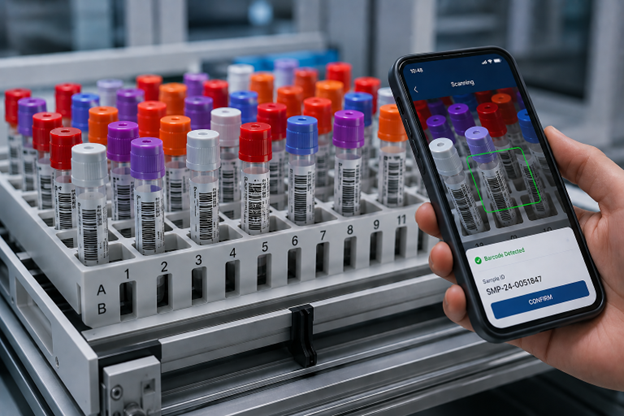
Laboratory environments introduce constraints that make consistent placement difficult to maintain.
In high-throughput workflows, racks are often removed, processed, and returned. Maintaining positional accuracy during these cycles is challenging due to:
- Dense layouts with visually identical tubes
- Frost and condensation reduce barcode readability
- Limited time for manual verification
- Reduced scanning reliability in low contrast conditions
These conditions make visual confirmation of placement difficult, increasing
As a result, labs frequently encounter:
- Sample misplacement
- Undetected swaps
- Loss of traceability
Limitations of Traditional Barcode Workflows for Sample Tracking
Traditional barcode workflows are designed for identification rather than placement validation.
Most barcode systems rely on sequential scanning or batch scanning without positional awareness.
Common limitations include:
-
Sequential scanning slows workflows. One-by-one scanning does not scale efficiently.
-
Batch scanning lacks positional context. Multiple barcodes may be captured, but without knowing where each sample is located within the rack.
-
Manual Tracking Breaks Down at Operational Scale. As sample volume and handling frequency increase, manual tracking methods cannot reliably maintain synchronization between physical rack positions and digital records.
Spreadsheet-based tracking becomes unreliable as scale increases.
Most systems answer: “What is this sample?”
But not: “Is this sample in the correct position?”
This gap is especially critical when samples are returned to storage after processing.
Adding Positional Context to Barcode Data for Sample Verification
Traditional barcode scanning identifies samples but does not indicate where each sample is located within a rack. In laboratory workflows, this missing spatial information can lead to misplaced samples and verification challenges.
To address this, barcode data should be coupled with each sample’s physical position in the rack. With Dynamsoft Batch Barcode Scanner, developers can detect multiple barcodes in a single image and obtain the location of each barcode within that image. By mapping these detected positions to the rack layout, each barcode can be associated with a specific slot.
This introduces positional context – a combination of
- Sample Identity (from barcode), and
- Sample Location (its position in the rack)
By combining these two pieces of information, barcode scanning evolves from simple identification into a placement verification mechanism. This allows systems to confirm not only what the sample is, but also whether it is in the correct position, reducing errors in sample handling and improving traceability.
Workflow Overview: From Scanning to Placement Verification

This approach introduces a structured validation loop into existing workflows.
Step 1: Baseline Scan
Capture all barcodes in the rack in a single scan to establish a reference dataset.
Step 2: Position Mapping
Map each barcode to a grid coordinate (e.g., A1–I9) and store this information in a structured format, such as CSV.
Step 3: Sample Processing
Perform standard lab operations, including testing or aliquoting.
Step 4: Verification Scan
Scan the rack again after processing to capture its updated state.
Step 5: Automated Comparison
Compare the verification dataset with the baseline and flag any discrepancies.
This process ensures that any change in placement is detected immediately.
Grid Mapping: Converting Physical Layout into Structured Data
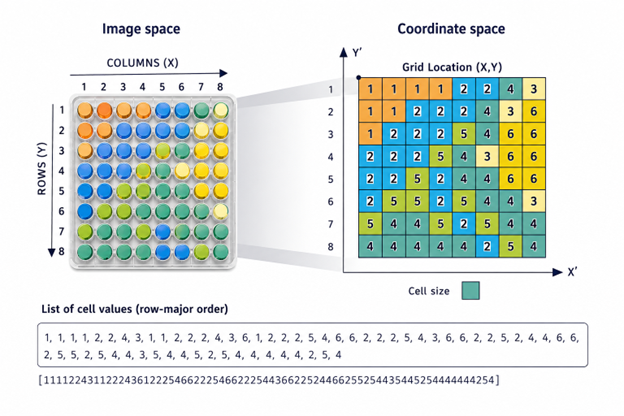
A key aspect of this approach is converting the rack layout into structured data.
Laboratory racks use a grid structure. Assigning coordinates, such as A1–I9, uniquely identifies each position.
This enables:
- Direct comparison between scans
- Simplified validation logic
- Structured, exportable datasets (CSV)
Treating the rack as a data grid makes placement validation systematic rather than manual.
Verification Logic: Detecting Placement Errors
Once both datasets are available, validation is a straightforward comparison process.
For each position:
- Match → correct placement
- Mismatch → incorrect sample
- Missing → sample not detected
- Unexpected → new sample detected
Example:
- Before: A1 → Tube123
- After: A1 → Tube789 → mismatch
This approach ensures that even minor placement errors are detected immediately.
Implementation Overview: From Camera Capture to Validation
Technically, this system builds on standard scanning workflows by adding spatial awareness.
Key components include:
- Camera-based scanning (mobile or handheld devices)
- Multi-barcode detection and decoding
- Coordinate-to-grid mapping logic
- CSV generation and dataset comparison
Dynamsoft Batch Barcode Scanner (BBS) delivers reliable multi-barcode detection and positional awareness, even in challenging laboratory conditions.
Benefits of Position-Aware Barcode Verification in Laboratory Workflows
By combining barcode data with positional information, labs can move from manual inspection to automated placement verification. This reduces placement-related errors while improving throughput and auditability.
Key benefits include:
-
Improved accuracy Misplaced or swapped samples can be detected immediately by comparing expected positions with actual scanned coordinates
-
Faster processing Entire racks can be scanned in a single pass, eliminating the need to handle and verify each vial individually
-
Enhanced traceability Systems can maintain records that link each sample not only to its identity, but also to its exact position over time
-
Support for automation Position-aware data enables integration with robotic systems and software workflows, removing the need for manual verification steps.
By catching placement errors at the point of scanning, this approach helps prevent downstream issues in analysis, reporting, and sample retrieval.
Use Cases: Where Position-Aware Verification Improves Lab Operations Accurate sample placement directly impacts operational reliability in real-world environments.
- Biobanks → maintain correct sample organization over time.
- Pharma labs → reduce costly placement-related errors.
- Research labs → ensure reproducibility and consistency.
In each case, placement verification adds a critical layer of control.
Conclusion: From Barcode Scanning to Placement Verification
Barcode scanning alone does not ensure correct sample handling. Without placement validation, errors may go undetected.
Combining multi-barcode scanning with grid-based mapping and dataset comparison ensures every sample is returned to its correct position after processing.
Get Started with Dynamsoft
If you are building or improving a lab workflow, the Dynamsoft Batch Barcode Scanner offers a strong foundation for efficient placement verification.
To get started:
- https://www.dynamsoft.com/barcode-reader/overview/
- https://www.dynamsoft.com/barcode-reader/docs/mobile/programming/ios/
- https://www.dynamsoft.com/barcode-reader/docs/core/programming/features/multiple-barcode-reading.html
- https://github.com/Dynamsoft
- https://www.dynamsoft.com/company/contact/
Frequently Asked Questions (FAQs)
What is positional context? It refers to linking each barcode to its physical position within a rack (e.g., A1–I9).
Why is placement verification important? It ensures samples are returned to the correct location, preventing misplacement and errors.
How does grid-based tracking work? Each rack position is mapped to a coordinate, enabling comparison between scans.
Can barcode scanning work in laboratory environments? Yes, with robust solutions like the Dynamsoft Batch Barcode Scanner, designed for low-contrast conditions.