


 Blog
Blog
MRZ on ID Cards and Travel Documents: Format, Parsing & OCR Guide
What Is MRZ (Machine Readable Zone) in Travel Documents?
The machine readable zone (MRZ) is a standardized code printed on passports and other identity documents to enable fast and accurate travel document scanning. Defined by the ICAO 9303 standard, the MRZ ensures that identity data follows a consistent structure across countries. The passport MRZ format encodes key information such as name, nationality, document number, date of birth, and expiration date in a machine-readable layout. Using MRZ OCR technology, systems can automatically extract and verify this data to support border control, identity verification, and secure document processing.
To harness the power of MRZ scanning, Dynamsoft offers the MRZ Scanner SDK, a robust software development kit designed to quickly and accurately read MRZs from various documents.
See it in action: Online MRZ Scanner Demo >
Key Takeaways
-
Global Standardization: MRZs follow ICAO formats (TD1, TD2, TD3), which enables consistent automated processing worldwide.
-
Speed & Accuracy: Automated MRZ scanning eliminates manual data-entry errors and accelerates identity verification.
-
Broad Coverage: MRZ technology supports passports, visas, and national ID cards in multiple regions.
-
End-to-End Verification: Combining MRZ OCR with face detection enhances identity validation workflows.
-
Implementation Guide: Learn to build a solution using our JavaScript passport scanner with MRZ OCR and face detection.
Here are some common types of ID cards and documents that have an MRZ:
1. MRZ in Passports
Most passports have an MRZ, typically found at the bottom of the identity page.
The MRZ in a standard passport typically consists of two lines, each 44 characters long. This format is known as the TD3 format. It includes information such as the passport number, issuing country, full name, nationality, date of birth, sex, and expiration date.
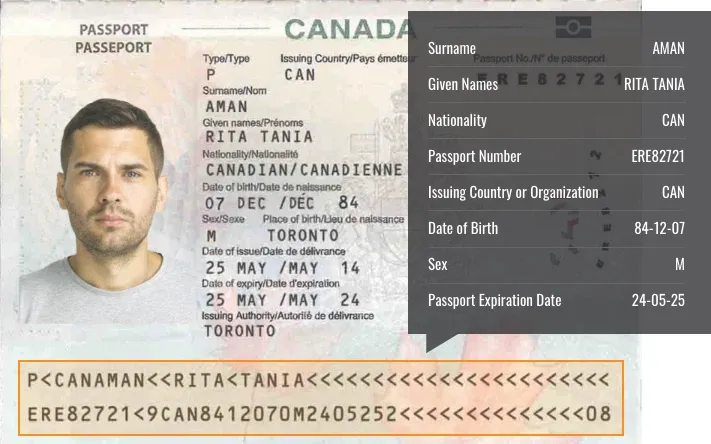
Some countries issue passport cards that have an MRZ with three lines of 30 characters each, known as the TD1 format. These are usually smaller than a standard passport book and are often used for specific types of travel, such as land and sea travel within certain regions.
Source: https://www.icao.int/publications/Documents/9303_p4_cons_en.pdf
2. MRZ on National ID Cards
National ID cards with a Machine Readable Zone (MRZ) are increasingly being adopted by many countries as a secure and convenient means of verifying an individual’s identity.
How different Countries Issue MRZ-Enabled National ID Cards:
European Union Countries:
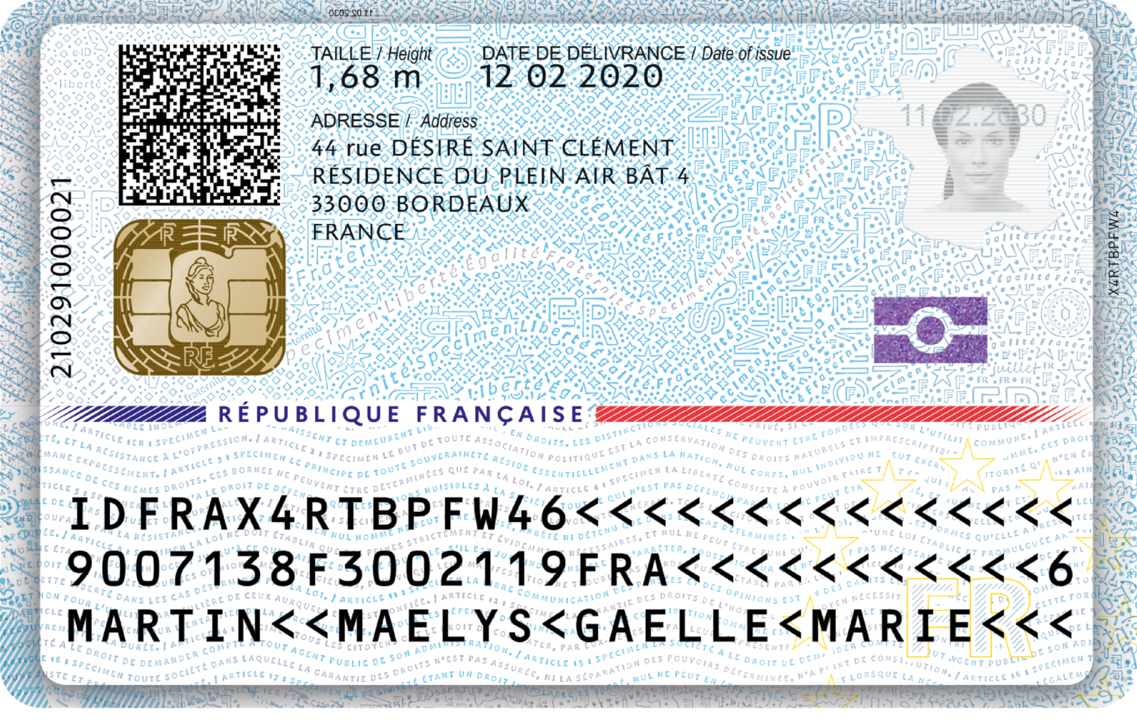
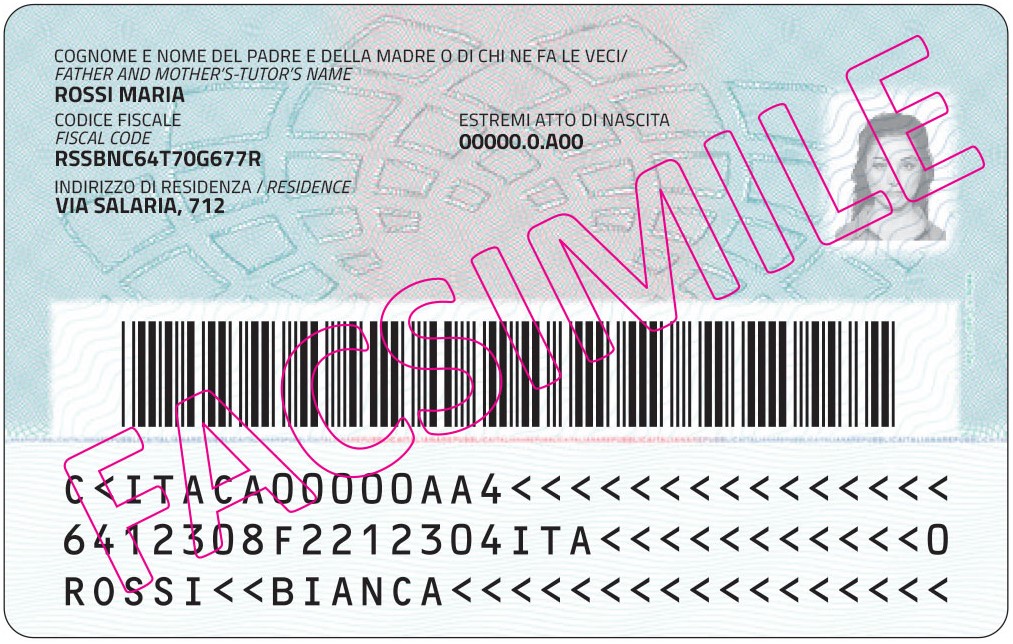
Countries like Germany, France, Italy, and Spain issue national ID cards with MRZ, which can be used for travel within the EU/Schengen Area.
German identity card
_R%C3%BCckseite.jpg)
National identity card (France)
Italian electronic identity card
Turkish identity card
.png)
Source:
- https://en.wikipedia.org/wiki/German_identity_card#/
- https://en.wikipedia.org/wiki/National_identity_card_%28France%29
- https://en.wikipedia.org/wiki/Italian_electronic_identity_card
- https://en.wikipedia.org/wiki/Turkish_identity_card
South American Countries:
Countries like Argentina and Brazil issue national ID cards that can be used for travel within the Mercosur region.
Countries of Other Regions:
Countries such as Malaysia (MyKad), Singapore, and South Korea issue national ID cards with MRZs, and while these cards are primarily used domestically, they may be accepted in certain neighboring countries or regions.
3. Applications of MRZ in Visa Stickers for Border Control and Identity Verification
Visas issued by many countries for entry into their territory may contain an MRZ to expedite processing at border controls.
Source: https://www.icao.int/publications/Documents/9303_p7_cons_en.pdf