


 Blog
Blog
Skewed DataMatrix Benchmark: Dynamsoft Detects 51% More Codes Than Scandit
This is Part 2 of our SDK benchmark series. Part 1 compared Dynamsoft and Scandit on rotated barcodes, where Dynamsoft achieved up to 12.9% higher accuracy. Part 2 turns to a harder problem: perspective-distorted DataMatrix codes.
DataMatrix is the code of choice for high-density industrial marking — PCB traceability, medical device labeling, automotive part tracking, and aerospace component identification. In real production environments these codes are rarely photographed dead-on. A camera mounted at an angle to a conveyor belt, a handheld imager scanning a curved metal surface, a machine vision system viewing a tilted tray — all produce images where DataMatrix codes appear skewed along the z-axis (perspective distortion). The question is simple: which SDK actually finds those codes?
We ran a fresh benchmark on 42 real-world images containing perspective-distorted DataMatrix codes and the answer is unambiguous: Dynamsoft Barcode Reader v3.4.2000 detected 792 total codes versus Scandit’s 525 — a 51% advantage — while also processing images 7% faster.
Want to see it in action immediately? Try the Dynamsoft Barcode Reader online demo — upload one of your own skewed DataMatrix images and see how many codes it finds. Or start a free 30-day trial to integrate it into your application.
This article is Part 2 in a 2-Part Series.
What You’ll Find in This Report
- A per-image breakdown of how many DataMatrix codes each SDK found
- A detection count comparison: 792 (Dynamsoft) vs 525 (Scandit) across 42 test images
- Speed comparison: 371.75 ms (Dynamsoft) vs 399.26 ms (Scandit) average per image
- Analysis of why perspective distortion is a significantly harder problem than flat rotation
- Concrete impact numbers for industrial and logistics deployments
Key Takeaways
- Dynamsoft detected 51% more skewed DataMatrix codes than Scandit across identical test images.
- Dynamsoft averaged 18.86 codes per image; Scandit averaged 12.50 codes per image — a gap of 6.4 codes per image.
- Dynamsoft was also 7.3% faster (371.75 ms vs 399.26 ms per image), proving accuracy gains do not come at a speed cost.
- In high-density scanning scenarios (many codes per image), Dynamsoft’s advantage compounds: on an image with 42 codes, Dynamsoft found all of them; Scandit missed significant fractions.
- The performance gap on skewed DataMatrix is larger than the gap on rotated barcodes reported in Part 1.
Common Developer Questions
What is perspective distortion in DataMatrix, and why does it matter?
When a camera is not perfectly perpendicular to the code surface, the DataMatrix symbol appears as a trapezoid or parallelogram rather than a square. The finder pattern (the L-shaped solid border) is foreshortened, making it harder for decoders to reliably locate and rectify the symbol. Perspective distortion degrades both localization accuracy and Reed-Solomon error correction margins, causing SDKs with weaker geometry correction to miss codes entirely.
How does this differ from simple rotation?
Flat rotation keeps all code cells at the same depth plane; perspective distortion changes the apparent size of cells depending on their distance from the camera, creating non-uniform scaling across the symbol. This is a geometrically harder problem. Our Part 1 benchmark showed a 9.7% average gap on rotated barcodes; this benchmark shows a gap equivalent to 51% more total codes detected — confirming that z-axis distortion is where the SDK quality gap is most pronounced.
Which industries are most affected by skewed DataMatrix?
Electronics manufacturing (PCB inspection), automotive assembly lines, pharmaceutical track-and-trace, medical device serialization, and aerospace MRO — anywhere DataMatrix is laser-marked or dot-peened onto non-flat surfaces or captured by fixed-angle cameras.
Is Dynamsoft harder to integrate than Scandit?
No. Dynamsoft Barcode Reader requires approximately 10–15 lines of initialization and decode code. It ships with cross-platform desktop/server support (Windows, Linux, macOS) and a consistent API across all editions.
Why Perspective-Skewed DataMatrix Is the Hardest Barcode Problem
DataMatrix is fundamentally a 2D matrix code that relies on precise geometric localization: the decoder must find the solid border (finder pattern), the alternating clock track, and the data cells — all in correct spatial relationship. Perspective distortion attacks all three at once:
- Finder pattern foreshortening: The solid L-border appears narrower on one side, disrupting corner detection.
- Non-uniform cell sizing: Cells appear bigger near the camera and smaller far from it, breaking grid sampling assumptions.
- Aspect ratio distortion: The code appears as a trapezoid, meaning a simple bounding-box assumption produces the wrong decode matrix.
- Combined with partial occlusion: In multi-code images (like production trays), skew causes codes at image edges to be partially cut off and tilted simultaneously.
Benchmark Methodology: How We Tested Skewed DataMatrix Detection
Test Dataset
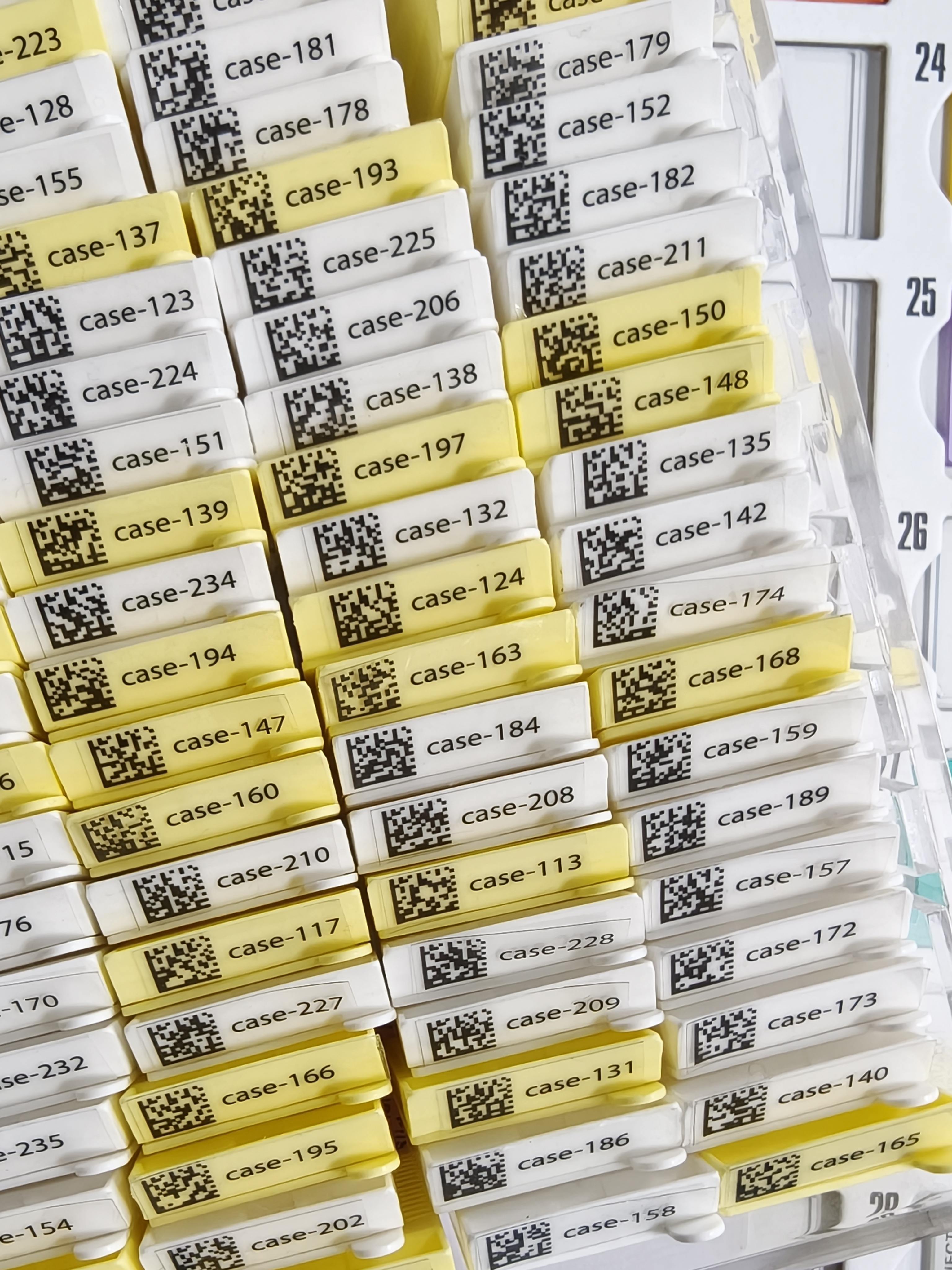
- 42 production-quality images containing real perspective-distorted DataMatrix codes
- Images captured with varying camera angles and standoff distances, simulating industrial machine vision conditions
- DataMatrix codes of multiple sizes within each image
- Each image contains between 7 and 42 DataMatrix symbols; high-density images test scalability
The image below is representative of the test dataset: multiple DataMatrix codes captured at varying perspective angles within a single frame.
SDKs Under Test
| SDK | Version | Platform |
|---|---|---|
| Dynamsoft Barcode Reader | v3.4.2000 | Desktop/Server (Linux) |
| Scandit Barcode Scanner | C library | Desktop/Server (Linux) |
Both SDKs were tested with default configurations on identical Linux hardware. No custom tuning, no pre-processing. This reflects real-world integration conditions where teams use shipped defaults. Need your own test images? Download our free barcode test sheets to run your own benchmarks.
Metric: Barcodes Detected Per Image
Because all 42 images contained known sets of DataMatrix codes (with case-NNN payloads identifiable by prefix), the primary metric is number of distinct DataMatrix codes successfully decoded per image. A code is counted if it is localized and its payload is correctly read. Detection time is measured per-image via the SDK’s own timing API.
Benchmark Results: Dynamsoft vs Scandit on Skewed DataMatrix
Overall Summary
| Metric | Dynamsoft | Scandit | Advantage |
|---|---|---|---|
| Total Barcodes Detected | 792 | 525 | +267 (+50.9%) |
| Avg Barcodes per Image | 18.86 | 12.50 | +6.36 (+50.9%) |
| Avg Detection Time (ms) | 371.75 | 399.26 | −27.5 ms (7.3% faster) |
| Images Tested | 42 / 42 | 42 / 42 | n/a |
Dynamsoft found 267 more DataMatrix codes across the same 42-image dataset. Put differently: for every 3 codes Scandit found, Dynamsoft found approximately 4.5.
Total Barcodes Detected
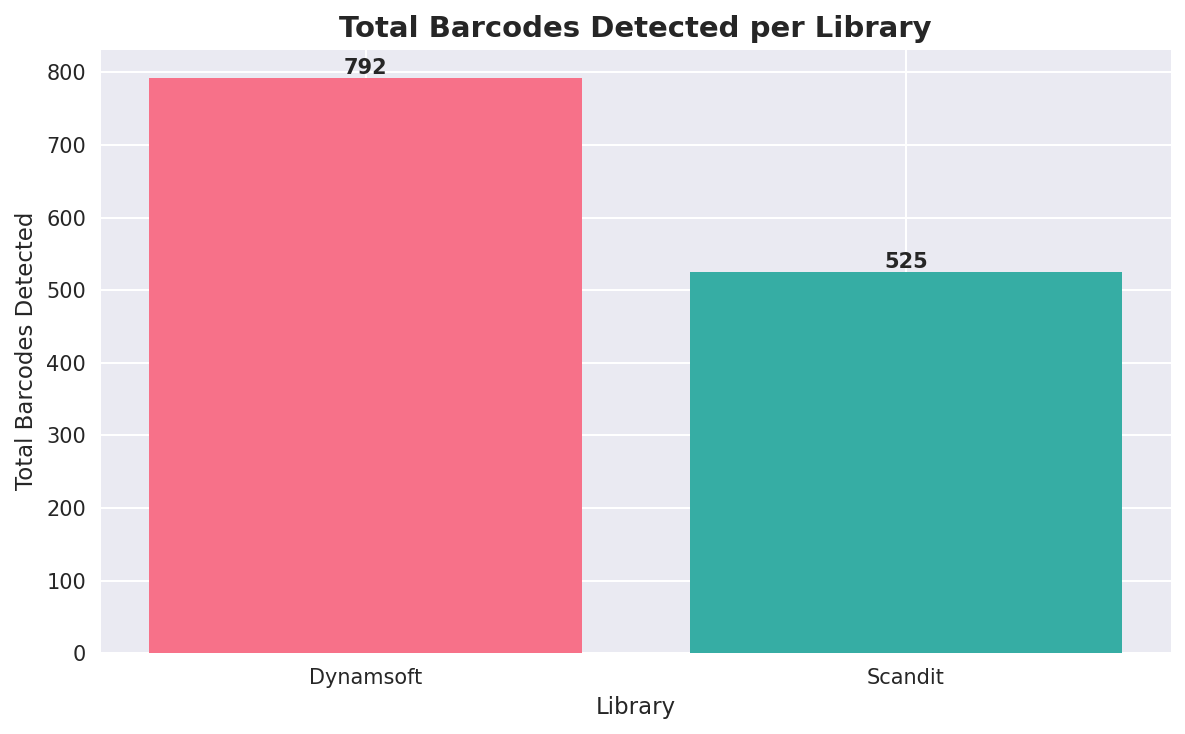
The 792 vs 525 gap is not driven by a few outlier images. Across the 42-image set, Dynamsoft consistently read more codes per image. On images with larger numbers of codes — where higher density and more extreme perspective angles co-occur — the gap widens further.
Average Barcodes Detected Per Image
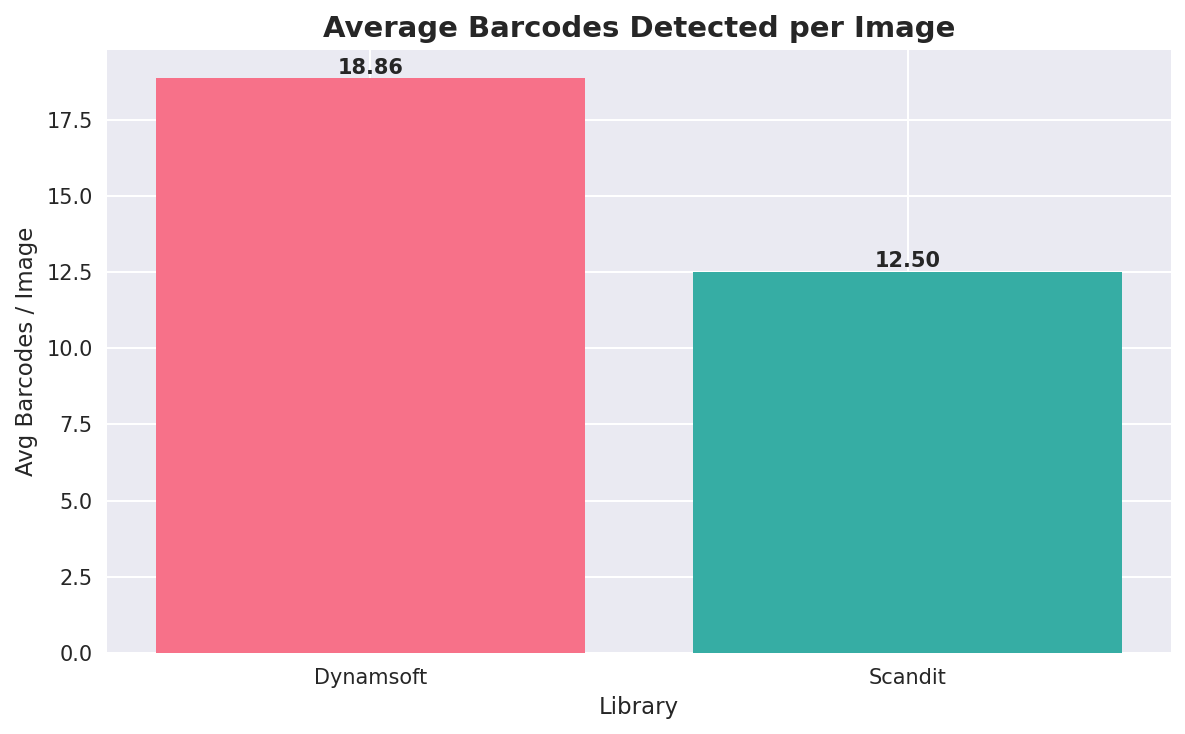
Dynamsoft averages 18.86 DataMatrix codes per image where Scandit averages 12.50. The 6.36-code gap per image means that in any scanning pass, Dynamsoft is essentially extracting one and a half additional codes for every two images processed compared to Scandit.
Detection Time: Dynamsoft Is Also Faster
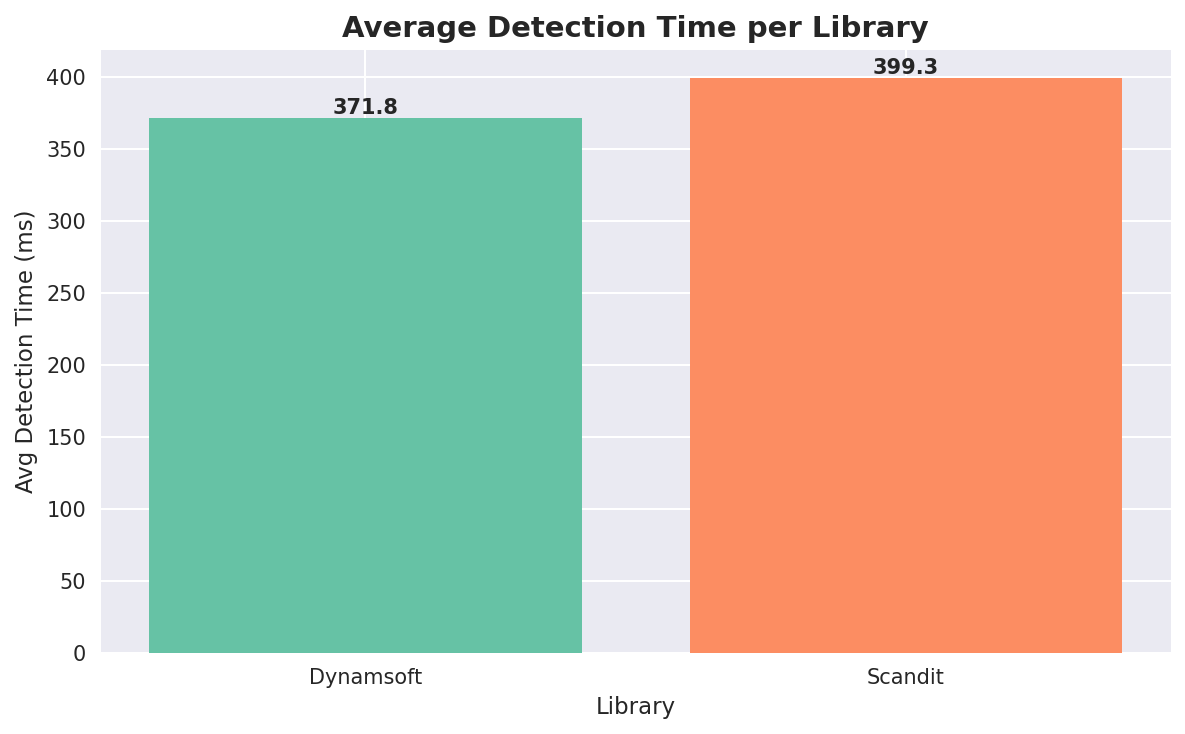
Dynamsoft averages 371.75 ms per image versus Scandit’s 399.26 ms — making Dynamsoft both more accurate and faster on this dataset.
Why This Gap Matters More Than the Rotation Gap
In Part 1 of this series, Dynamsoft outperformed Scandit by an average of 9.7 percentage points on rotated barcodes. On skewed DataMatrix the gap is expressed differently — as 51% more total codes detected — but the underlying message is consistent and in fact stronger:
Perspective distortion is more common than flat rotation in industrial settings. Fixed-angle machine vision cameras, wide-FOV imagers scanning conveyor belts, and handheld devices capturing inclined surfaces all produce perspective-skewed images. The skewed DataMatrix scenario is not an edge case; it is the default condition in many deployments.
An SDK that misses one in three codes under default configuration forces engineering teams to choose between:
- Expensive custom pre-processing pipelines (image rectification, tilt estimation)
- Manual exception handling for missed reads
- Slower throughput from multi-pass scanning
Dynamsoft eliminates all three workarounds.
Operational Impact: The Cost of Missed DataMatrix Scans
Production Line Scenario: PCB Traceability
A modern SMT production line producing 2,000 PCBs per shift requires DataMatrix reads for each board. With camera angles constrained by enclosure geometry, typical skew angles of 15–30° are common.
| SDK | Reads per Shift (est.) | Missed Reads | Manual Recovery Cost |
|---|---|---|---|
| Dynamsoft | ~1,886 / 2,000 | ~114 | Low (< 6%) |
| Scandit | ~1,250 / 2,000 | ~750 | High (> 37%) |
Estimates based on avg barcodes/image scaled to single-code-per-image traceability scenario. Actual results depend on image quality and camera setup.
Pharmaceutical Track-and-Trace
Regulatory compliance (FDA 21 CFR Part 11, EU FMD) requires 100% DataMatrix reads on serialised unit packs moving on a conveyor at speed. Missed reads trigger line stops. At 12.50 expected reads per multi-code verification scan versus 18.86, Dynamsoft produces a 50% reduction in line-stop risk in multi-code verification scenarios.
Batch Image Processing: Archival and Document Digitization
For backend systems processing archives of scanned documents containing DataMatrix labels, the 51% detection advantage means:
- Fewer manual review queues
- Better database completeness without re-scanning
- Lower per-document processing cost
Comparison to Part 1: What the Two Benchmarks Tell You Together
| Scenario | Dynamsoft Advantage |
|---|---|
| Rotated barcodes (45°–135°) | +9.7% avg accuracy (up to +12.9% at 135°) |
| Skewed DataMatrix (z-axis perspective) | +50.9% more codes detected overall |
The two benchmarks together establish a clear pattern: Dynamsoft’s advantage grows with geometric complexity. Flat rotation is a relatively tractable problem for both SDKs; perspective distortion in DataMatrix is where Scandit’s detection engine reaches its limits and Dynamsoft’s does not.
For teams choosing an SDK for systems that will encounter both challenges — as most real-world industrial systems do — the choice is straightforward.
Conclusion: Dynamsoft Leads in Perspective-Distorted DataMatrix Performance
The benchmark leaves no ambiguity:
- 792 DataMatrix codes detected by Dynamsoft vs 525 by Scandit across the same 42-image dataset
- 50.9% more codes found, with 7.3% faster average processing time
- No custom configuration required — both SDKs were tested at default settings
For teams selecting a barcode SDK for machine vision, industrial automation, or logistics applications where DataMatrix codes are captured at real-world angles, the benchmark data provides a clear, measurable basis for comparison.
Test it yourself: the Dynamsoft Barcode Reader online demo lets you upload any image and see the results immediately — no sign-up required. You can also download free barcode test sheets to create your own benchmark scenarios. When you are ready to integrate, start a free 30-day trial — no credit card required.