


 Blog
Blog
What is a Digital Product Passport (DPP)? A Detailed Guide for Manufacturers

A Digital Product Passport (DPP) is a structured, machine-readable record that details a product’s identity, materials, origin, sustainability, repairability, and end-of-life handling. Each DPP links to the physical product via a permanent unique identifier encoded on a data carrier such as a QR code, Data Matrix, or RFID tag. The EU Ecodesign for Sustainable Products Regulation (ESPR), Regulation (EU) 2024/1781, establishes the DPP and defines requirements for each product group through separate delegated acts.
The entire passport is not stored in a central location; the EU DPP Registry, which began operation on 20 July 2026, contains only the identifiers and the registration metadata. The full record stays with the economic operator or with an authorized service provider. The first binding obligation relates to the battery passport and comes into effect on 18 February 2027.
For manufacturers and importers, the DPP is a systems requirement rather than a documentation task. All affected product groups must include a unique identifier, a durable data carrier, structured data, and role-based access control.
Key Takeaways
- A Digital Product Passport is a structured record containing information on materials, product origin, sustainability, and end-of-life data, all linked to the item by a persistent identifier.
- Batteries are the first product group with a fixed statutory date. Starting 18 February 2027, a passport will be required for every EV battery, every light means of transport battery, and every industrial battery above 2 kWh.
- DPP obligations apply to all products placed on the EU market, including those from non-EU manufacturers.
- Complete DPP data is not stored in a central EU database. The Registry holds only identifiers, while records remain with the economic operator or an authorized service provider.
- Access to DPP data is role-based, ensuring consumers, repairers, recyclers, and authorities see only information relevant to their needs.
- On-device decoding tools store scanned images and identifiers within your network, which is essential for meeting data residency requirements.
Why is the EU introducing the Digital Product Passport?
The EU is introducing the Digital Product Passport to ensure reliable product information is available throughout the value chain. This supports product longevity, improves material recovery efficiency, and helps identify non-compliant goods. Key issues addressed include limited access to disassembly details for repairers, lack of substance information for recyclers, and post-import compliance checks by customs authorities.
Which industries need a Digital Product Passport, and when?
The battery industry is the first affected, with DPP requirements becoming mandatory for electric vehicles, light vehicles, and industrial batteries on 18 February 2027. Other sectors will follow through separate delegated acts, with at least 18 months provided for transition after each act is adopted.
| Product group | Governing instrument | Indicative milestone |
|---|---|---|
| Batteries (EV, light transport, industrial) | Batteries Regulation (EU) 2023/1542 | Mandatory 18 February 2027 |
| Iron and steel | ESPR delegated act | Adoption expected Q4 2026 |
| Construction products | Construction Products Regulation | Delegated act expected Q2 2027 |
| Textiles, aluminum, tires | ESPR delegated acts | Adoption expected Q3–Q4 2027 |
| Furniture | ESPR delegated act | Adoption expected 2028 |
| Mattresses and ICT products | ESPR delegated acts | Adoption expected 2029 |
Under the Batteries Regulation (EU) 2023/1542, only batteries have a fixed statutory date of 18 February 2027. Iron and steel are the first group under ESPR, with adoption expected in the fourth quarter of 2026. Construction products will have a delegated act in the second quarter of 2027. Textiles, aluminum, and tires are scheduled between the third and fourth quarters of 2027; furniture in 2028; and mattresses and ICT products in 2029. Packaging, critical raw materials, toys, and detergents have separate regulations, with all dates subject to change.
What sort of information is included in a Digital Product Passport?

A Digital Product Passport contains a permanent unique product identifier and structured information on identity, composition, sustainability, and end-of-life disposal. The delegated act for each product group defines the specific data fields. According to the European Commission, the passport may include information on safety, origin, materials, repairability, environmental performance, and recycling. Since fields vary by delegated act, the critical requirement is the ability to identify each item, rather than relying on a fixed data schema.
What mistake do manufacturers make regarding DPPs?
A common misconception is that a Digital Product Passport is simply a QR code or Data Matrix on packaging. In reality, the code only carries data, while the passport comprises the identifier, structured record, access framework, and registry entry. Three common misconceptions are listed below.
- “Our existing QR code covers it.” Existing QR codes are insufficient, as a passport must link to an updatable record that provides different data to different user roles.
- “We are outside the EU, so this does not apply.” Being outside the EU does not exempt products from DPP requirements. Duties apply to all products placed on the EU market, and customs authorities can examine imports.
- “ESPR is in force, so we are already compliant.” Although ESPR is in effect, no delegated act has yet imposed DPP obligations on any product group.
What is the correct way to assess DPP scanning tools?
Evaluate DPP capture tools based on symbology coverage, structured parsing, real-world readability, supported platforms, on-device data processing, and deployment flexibility.
Carrier coverage, parsing, and readability
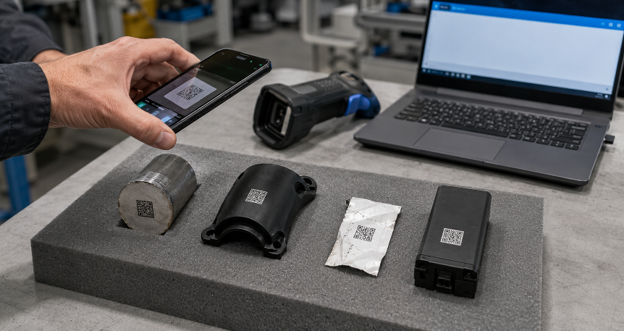
Tools must interpret 2D symbols used by carriers and convert the payload into individual fields, not just a single string. The GS1 Application Identifier syntax combines data such as GTIN, batch number, serial number, and production date into a concatenated string separated by non-printable FNC1 characters, which generic scanners do not parse. Carriers also label steel billets, molded housings, and battery casings, making direct part marking and resistance to motion blur more important than performance on test images.
Security, data residency, and deployment
Clearly define where scanned data is stored. If decoding occurs in a cloud service, product images and payloads leave your network. With on-device decoding, both remain on the user’s machine. Air-gapped environments require offline licenses, and distributed teams should use centralized license management rather than individual licenses for each machine.
How Dynamsoft solutions can help
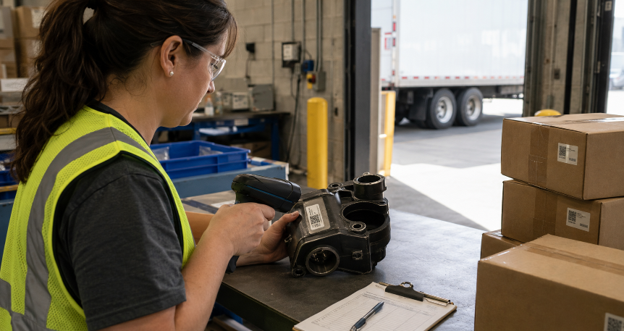
Dynamsoft provides the capture component of a DPP implementation—the software that reads the data carrier on a physical product and converts its contents into structured fields. Dynamsoft is not a DPP hosting service nor a compliance database; it is the element that enables the physical-to-digital linkage to function at the goods-in stage, on the production line, and at the recycler’s facility.
What carriers and platforms does Dynamsoft Barcode Reader support?
The Dynamsoft Barcode Reader supports more than 30 different symbologies, such as QR Code, Micro QR Code, Data Matrix, GS1 DataBar, GS1 Composite, and GS1 DataMatrix, via a single consistent API that extends to JavaScript, native iOS and Android, Flutter, React Native, MAUI, Python, Java, .NET, C++, and Node.js.
How does Dynamsoft parse GS1 barcode data into structured fields?
Dynamsoft Code Parser supports version 24.0 of the GS1 Application Identifier definitions standard and displays the AIs as named fields. A number of these mappings correspond directly to DPP themes: AI 01 relates to the GTIN, AI 21 to the serial number, AI 422 to the country of origin, AI 425 to the country of disassembly, AI 7230 through AI 7239 to certification references, AI 7020 to the refurbishment lot ID, and AI 8030 to a digital signature.
How well does Dynamsoft read damaged or directly marked codes?
True real-world readability is achieved through algorithms that can handle blurred, damaged, and low-contrast barcodes, as well as allow for direct marking on metal and curved surfaces, together with the ability to deal with deformed labels, all of which can be adjusted using customizable scan templates to optimize the decoding process. According to Dynamsoft’s own benchmark involving 337 barcodes and 16 image quality categories, it decoded 32.7% more barcodes than the next-best SDK tested.
When using Dynamsoft, where does the scanned data go?
Dynamsoft Barcode Reader operates entirely offline and directly on the device, regardless of the platform, with a WebAssembly core in the browser and native libraries elsewhere. Nothing about the image or barcode data is sent to any external servers, and the scanned images and decoded identifiers remain on the user’s machine within your network. Dynamsoft is ISO 27001- and O-TTPS-certified, has published a security white paper, and provides offline licensing as well as license-server deployment.
With high-volume checks such as incoming inspection, the Dynamsoft Batch Barcode Scanner can decode hundreds of barcodes in a single go.
To test this with your own labeled parts, you can use the GS1 read-and-parse demo, which runs in the browser, and the 30-day free trial includes direct engineer support.
Frequently asked questions (FAQs)
What is a Digital Product Passport (DPP)?
A Digital Product Passport (DPP) is a structured, machine-readable document that provides information about a product’s identity, materials, origin, sustainability, repairability, and end-of-life handling. It is linked to the physical product by a permanent unique identifier encoded on a data carrier such as a QR code, Data Matrix, or RFID tag. The EU Ecodesign for Sustainable Products Regulation (EU) 2024/1781 established the DPP and set requirements for each product group through separate delegated acts. The battery passport is the first binding obligation, effective from 18 February 2027.
Is the Digital Product Passport identical to a QR code?
A Digital Product Passport is not to be confused with a QR code; the QR code is the data carrier which encodes the unique identifier, whereas the passport is the comprehensive system involving record-keeping, access rights, and an entry in the Registry.
Does the Digital Product Passport apply to manufacturers who are based outside the EU?
The obligation relating to Digital Product Passports applies to non-EU manufacturers when they put their products on the European Union market; EU-produced products have to be registered before they are placed on the market, and imported products can be checked at customs.
Where is the data for the Digital Product Passport actually stored?
The Digital Product Passport data is stored by the responsible economic operator or an authorized DPP service provider, not in a central EU database; the EU Registry keeps only the unique identifiers and registration metadata, so the actual product data remains under the operator’s control.
Who can see the information contained in a Digital Product Passport?
Access to information in the Digital Product Passport is based on a person’s role and is regulated by the relevant EU law. Thus, consumers, repairers, recyclers, and authorities each obtain only the information pertinent to their activities, meaning commercially sensitive data is not automatically made publicly available.
What data carriers are allowed for a Digital Product Passport?
The digital product passport can use 2D symbols such as QR Code and Data Matrix as well as RFID and NFC tags, the requirements for which are specified in the CEN/CENELEC standards for the DPP. GS1 Digital Link is a commonly used encoding method that encodes the identifier as a resolvable URL within a QR code.
Is the Digital Product Passport currently mandatory?
A Digital Product Passport is still not required for ESPR product groups as of August 2026; the EU Registry came into operation on 20 July 2026, but the first binding product obligation, that being the battery passport, will be on 18 February 2027.
Is an app download or an internet connection needed for DPP scanning?
DPP scanning is designed to work without a dedicated app download, since at least one carrier must be readable with an ordinary smartphone. Retrieving the record requires connectivity, but decoding the symbol can happen offline when the application uses an on-device engine.
Getting ready for the Digital Product Passport
The Digital Product Passport transforms product transparency from an on-demand document into a continuously operating infrastructure. While specific dates may change, the core architecture is established: a persistent identifier, a durable machine-readable carrier, a structured record, and role-based access. This year, focus on validating the physical-to-digital link for your products, as marking and reliably reading a Data Matrix on steel differs significantly from printing a QR code on a carton. For guidance, consult Dynamsoft Barcode Reader documentation.