


 Blog
Blog
Choosing the Right Data Capture Tech: IoT, RFID, or Barcodes?
Modern organizations run on data. From retail shelves and warehouse pallets to manufacturing tools and sensitive pharmaceuticals, businesses need to know what they have, where it is, and in what condition it is. Barcodes, RFID, and IoT sensors are among the most widely used data collection methods, but each serves a different purpose, and choosing the right one can significantly impact cost, efficiency, and visibility.
While some industries still rely on a single technology, many organizations are adopting hybrid approaches to combine affordability, automation, and real-time intelligence. Understanding the strengths and limitations of each technology can help decision-makers design a data capture strategy that scales with their operations.
Barcodes: The Foundation of Everyday Tracking

Barcodes remain the most common and cost-effective method for tracking items across industries. When comparing RFID vs barcode, barcodes are typically the preferred choice for organizations seeking simplicity, low cost, and universal compatibility. They are easy to print, easy to scan, and integrate seamlessly with existing systems. For item-level identification, especially in high-mix environments, barcodes are often the default choice.
Advantages
- Very low cost per label
- Mature technology with universal compatibility
- High accuracy, especially with 2D codes, such as, DataMatrix codes and QR codes.
- Runs on any camera-equipped device with modern SDKs
Limitations
- Requires line-of-sight scanning
- Manual handling or positioning is needed.
- Can slow down high-volume workflows unless batch scanning is used
Best Fit
Retail products, warehouse inventory, pharmaceutical items, manufacturing components, documents, ID cards, and anywhere precise item-level identification is critical.
RFID: Ideal for Speed and Automation
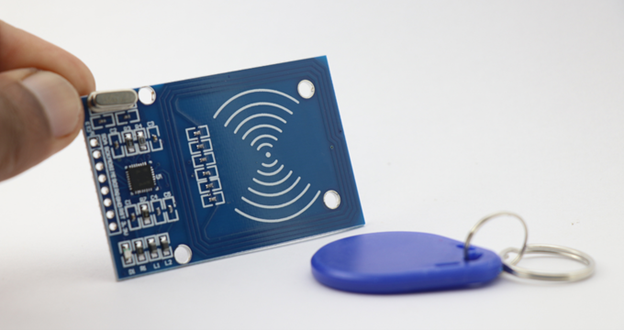
RFID offers a different value proposition: instead of scanning items one by one, RFID allows multiple tagged objects to be detected automatically, from a distance, and without line of sight. This makes it a strong choice for high-volume, fast-moving, or automation-heavy environments.
Advantages
- Bulk reading of many items at once
- No line-of-sight requirements
- Supports hands-free automation (portals, conveyors, gates)
- Durable reusable tags for assets, tools, bins, and garments
Limitations
- Higher cost for tags and reader infrastructure
- Read reliability can be affected by metals or liquids
- Requires careful antenna setup and zone planning
- Active RFID requires battery maintenance
Best Fit
Warehouse dock doors, tool tracking, reusable shipping containers, manufacturing WIP, apparel retail inventory, libraries, and asset rooms.
IoT Sensors: Visibility Beyond Identification

IoT devices go a step further by offering continuous monitoring. Instead of simply knowing “what and where,” IoT provides “how it’s doing”: temperature, vibration, humidity, location, motion, and more. IoT is best suited for high-value assets or environments where conditions matter as much as movement.
Advantages
- Real-time telemetry and alerts
- Tracks both location and environmental metrics
- Ideal for mobile, high-value, or mission-critical assets
- Supports long-range and remote connectivity (BLE, LoRaWAN, cellular)
Limitations
- Higher device and network cost
- Requires power management and device provisioning
- Overkill for low-value or high-volume items
- May require integration with IoT platforms or cloud services
Best Fit
Cold chain logistics, pharmaceutical distribution, fleet assets, industrial equipment monitoring, food supply chains, and remote field operations.
Side-by-Side Comparison
| Data Capture Technology | Strengths | Limitations | Use Cases |
|---|---|---|---|
| Barcodes | Low cost, easy to deploy, high accuracy | Line-of-sight, manual handling | Retail, warehouse inventory, healthcare, manufacturing |
| RFID – Passive | Bulk reads, no line-of-sight, automation-ready | Higher cost, interference issues | Logistics, apparel retail, tool rooms, WIP tracking |
| RFID – Active | Long range, real-time location | Battery maintenance, highest cost | Vehicles, mobile equipment, high-value assets |
| IoT Sensors | Continuous monitoring, environmental data, alerts | Complex deployment, device/battery management | Cold chain, industrial equipment, pharmaceuticals |
How to Make the Right Choice
Selecting the right technology depends on workflow design, asset value, and the level of visibility required. Below are key decision factors to consider.
1.Volume and Throughput Needs
The speed and scale of item movement often determine the feasible technology. High-velocity operations need automation-friendly solutions, while human-assisted workflows can rely on simpler tools.
- High volume with rapid movement: RFID or automated gates
- Moderate volume with human handling: Barcodes with batch scanning
- High-value, low-volume items: IoT sensors
2. Automation Requirements
The degree of automation required in your process has a direct impact on technology choice. Consider how much human intervention you want to eliminate and what level of operational consistency you need.
- Minimal automation: Barcodes are cost-efficient and reliable
- Moderate automation: RFID for hands-free identification
- Continuous insight: IoT for telemetry and alerting
3. Environmental Conditions
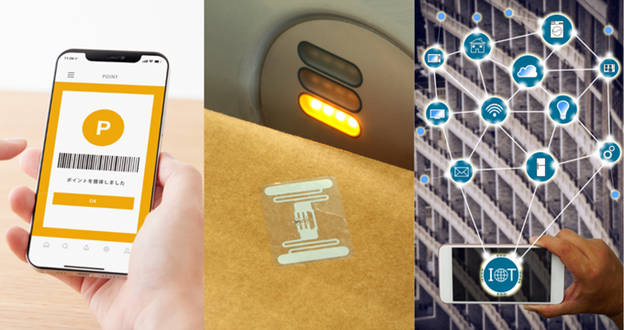
Operating environment can influence signal accuracy, hardware durability and the overall reliability of the system, evaluate any physical or environmental constraints early to avoid performance setbacks.
- Metal-heavy or liquid-based environments may impact RFID performance
- Harsh or temperature-sensitive environments benefit from IoT monitoring
4. Asset Value
The financial or operational value of the asset helps justify the tracking investment. Higher-value items can support more sophisticated tracking while low-cost items require scalable, low-CAPEX solutions.
- Low-value, disposable items: Barcodes
- Medium-value, reusable items: RFID
- High-value or sensitive assets: IoT sensors
5. Integration Capabilities
Any chosen technology must work with existing WMS, ERP, MES, LIMS, or other enterprise systems. Barcodes integrate easily through enterprise-grade SDKs, while RFID and IoT may require additional middleware.
When Hybrid Approaches Offer the Best ROI
In many real-world scenarios, no single technology is enough. A layered model provides flexibility, scalability, and cost-efficiency. Many organizations implementing modern data collection methods now combine the three to achieve comprehensive visibility.
- Barcodes for item-level ID
- RFID for container-, rack-, or batch-level movement
- IoT sensors for environmental and real-time condition monitoring
For example, a cold chain operation might label each product with a barcode, track each cooler or pallet with RFID, and monitor temperature and vibration using IoT sensors. Combined, this creates a complete digital record from production to delivery.
How Dynamsoft Supports Your Data Capture Ecosystem
Across industries, barcodes remain a trusted and widely used data capture technology, even in environments that also leverage RFID or IoT. Dynamsoft focuses on enabling that barcode layer with high-performance, camera-based decoding that fits into both traditional workflows and modern automated systems.
Dynamsoft helps companies implement reliable tracking systems with:
- Advanced barcode scanning SDKs for mobile, desktop, and web
- Batch barcode scanning for high-volume environments
- Machine vision capabilities for automated workflows
- Easy integration with enterprise systems in logistics, manufacturing, healthcare, and retail
Dynamsoft’s proven barcode scanning technology complement RFID or IoT-based systems by providing the precise, item-level identification needed to ensure end-to-end traceability.
The Next Steps
Barcodes, RFID, and IoT sensors each play a distinct role in modern data capture strategies. Barcodes provide affordable, universal identification; RFID enables fast, automated tracking; and IoT delivers continuous, real-time monitoring. Most organizations benefit from a hybrid solution that combines these strengths to match varying asset types, workflows, and operational goals. With Dynamsoft’s high-performance Data Capture SDKs, businesses can confidently implement the right mix of technologies to achieve accurate, scalable, and future-ready visibility.
Contact our specialists to discover the ideal solution for your needs.
Test our barcode scanner with the online demo.
Get the Dynamsoft Batch Barcode Scanner from the App Store.