


 Blog
Blog
How to Eliminate the 1% Barcode Failure Trap in Automated Laboratories
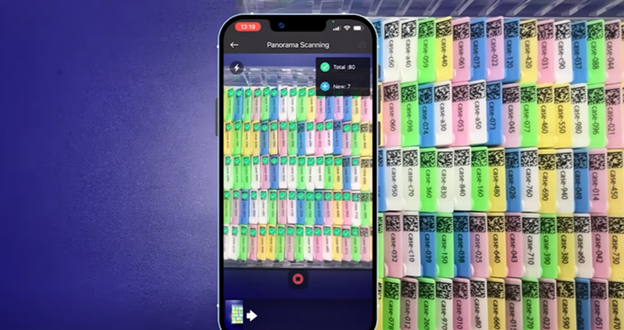
Why a 1% Read Failure Rate Creates Outsized Manual Work and Throughput Loss
In high-throughput laboratory automation, most systems are built for standard scenarios, and a 99% barcode read success rate is often deemed sufficient.
At scale, this assumption fails. In a facility processing 50,000 samples daily, a 1% failure rate results in about 500 barcode no-reads per day. Each no-read, whether caused by damaged labels, poor print quality, condensation, or ambiguity, triggers manual intervention, reducing throughput, increasing labor costs, and undermining operational predictability.
This pattern defines the 1% Failure Trap: a small but recurring exception rate that steadily erodes the core value of automation.
The Disproportionate Cost of No-Reads in Automated Laboratory Workflows
When an automated system cannot decode a barcode, the response is rarely automated. Instead, inefficiencies spread throughout the workflow.
- System Interruption: Conveyors slow or pause, robotic handlers wait, and the line shifts to conservative operating modes. Buffers increase and cycle times lengthen to manage uncertainty.
- Manual Intervention: An operator must verify, re-scan, or re-label the sample. This adds labor costs, delays, and variability to an otherwise predictable process.
- Data Integrity Risk: Manual entry of a sample identifier weakens the digital chain of custody. Human error rates are higher than machine-generated reads, increasing compliance and traceability risks in pharmaceutical and diagnostic settings.
While each incident may seem minor in isolation, its cumulative effect reduces throughput and limits the feasibility of sustained unattended operation.
Why Traditional Pass/Fail Barcode Decoding Fails in Real Laboratory Conditions
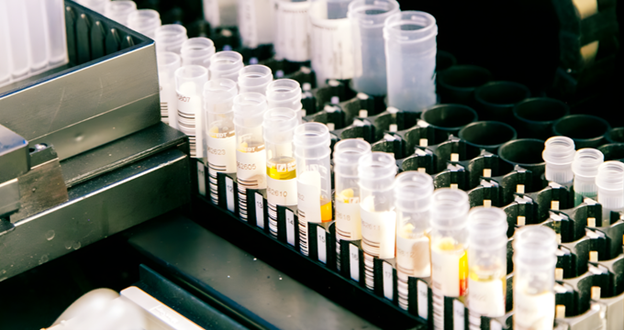
Most barcode failures are not due to unreadable symbols. They occur when real-world conditions like condensation, low contrast, partial occlusion, or perspective distortion fall just outside strict decoding thresholds.
Traditional decoding engines use binary pass/fail logic. If a barcode does not meet predefined quality criteria, it is rejected.
Addressing the 1% failure rate requires a new approach. Barcode decoding should use tolerance-aware assessments within defined symbology error-correction limits, rather than relying solely on absolute thresholds. This enables recovery of valid identifiers without compromising data integrity.
How Dynamsoft Barcode Reader Reduces No-Reads Through Software-Based Resolution
Let us examine how Dynamsoft Barcode Reader SDK addresses the ‘1% Failure Trap’ in Clinical Diagnostics and Pharmaceutical Laboratory Automation.

1. Advanced Image Preprocessing for degraded lab labels
Many decode failures can be addressed before decoding begins. Dynamsoft uses adaptive preprocessing techniques to enhance degraded image regions, including localized contrast adjustment, binarization for complex or reflective backgrounds, and sharpening of weakened module edges from chemical exposure or label wear.
2. Error-Correction Decoding for Partially Damaged Barcodes
Instead of relying solely on rigid thresholds, Dynamsoft uses fuzzy-logic models to determine whether a barcode can be reliably decoded within the symbology’s error-correction tolerances. This enables recovery of partially damaged or occluded DataMatrix codes without increasing false positives or compromising data integrity.
3. Geometric Deskewing for Curved and Angled Sample Containers
Barcodes printed on curved vials or tubes are often distorted by perspective. Dynamsoft applies geometric deskewing algorithms to correct curvature and angular distortion, enabling accurate decoding without mechanical rotation or repositioning.
Replacing Manual Exception Handling with Automated Recovery
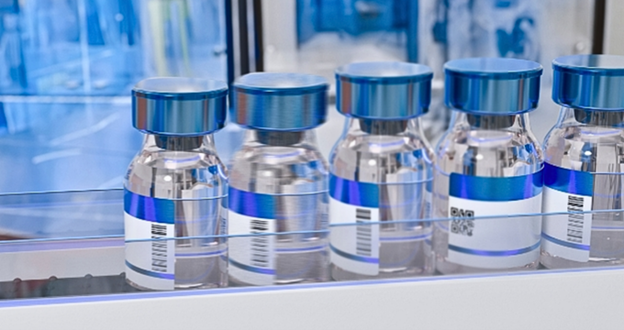
Replacing manual exception handling with intelligent decoding fundamentally changes how laboratories address failure scenarios.
Handling Condensation and Frost Without Manual Re-Scanning
In environments affected by frost or condensation, traditional workflows rely on wiping labels and re-scanning samples. With Dynamsoft’s adaptive preprocessing, visual obstructions are digitally corrected, enabling successful reads without physical intervention.
Recovering Data from Torn or Partially Visible Labels
For torn or damaged labels that would typically result in a “no read” and sample rejection, error-tolerant decoding allows barcodes to be captured within symbology limits, significantly reducing discard rates.
Decoding Barcodes on Curved or Skewed Vials Without Mechanical Adjustment
When vials are curved or skewed, manual processes often require mechanical rotation. Software-based geometric deskewing eliminates this step by correcting distortion algorithmically.
Even in cases of partial barcode visibility, where re-scanning is usually necessary, multi-frame reconstruction combines sequential image frames to decode barcodes without stopping motion.
Conclusion: Automation Is Defined by Its Edge Cases
Automation systems are not defined by performance under ideal conditions but by how effectively they handle imperfections.
Reducing exception rates from 1% to 0.1% significantly improves operational stability. It enables tighter scheduling, reduces labor dependence, and supports true lights-out operation. By addressing edge cases through intelligent decoding rather than manual intervention, laboratories move closer to automation that is not only faster but also truly autonomous.
Key Takeaways
-
The 1% Trap: In a lab processing 50k samples/day, a “good” 99% read rate still results in 500 manual interventions. That isn’t automation; that’s a bottleneck.
-
Throughput Killer: Every “no-read” isn’t just a label issue, it’s a system-wide pause that erodes your ROI.
-
The Software Shift: Solving edge cases like frost, condensation, and curved vials at the software level restores “lights-out” predictability.