


 Blog
Blog
High-Density Microplate Barcode Scanning: Why Localization Is the Real Bottleneck

What Changes When Moving from 96 to 384 and 1536-Well Microplates?
Laboratory automation is moving toward higher density within the same footprint. As screening and genomics workflows transition from 96-well plates to 384-well and 1536-well formats, each camera frame captures each captured image contains hundreds of small, closely spaced 2D barcodes.
For automation developers, the primary challenge is accurately locating hundreds of small, low-margin 2D barcodes in a single high-resolution image while maintaining consistent performance. In dense microplate workflows, barcode localization, not decoding accuracy, is the main performance constraint.
Why Barcode Localization Becomes the Performance Bottleneck in High-Density Plates
A full-frame image of a 384-well plate can exceed 20 megapixels. Traditional barcode engines scan every pixel, treating the image as a uniform search space, which does not scale efficiently. As barcode density increases, brute-force localization results in:
- CPU saturation and unpredictable processing spikes.
- Plate-level processing times measured in seconds rather than milliseconds.
- User interface lag during image analysis.
- Increased false positives from background noise between wells.
In high-throughput screening, these effects are significant. If image processing takes longer than mechanical transport, the imaging subsystem limits overall throughput.
The Full-Frame Search Problem in in Dense Microplate Imaging
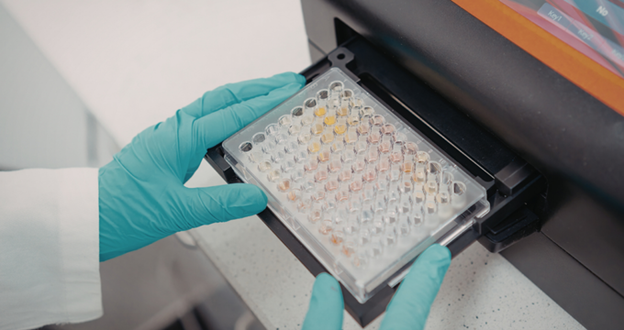
The core issue is excessive searching rather than decoding logic.
Barcode locations are predictable based on plate geometry, well spacing, camera alignment, and barcode dimensions. However, many systems ignore this structure and perform full-frame searches, wasting processing cycles on irrelevant areas.
As density increases from 96 to 384 to 1536 wells, inefficiency increases rapidly. Efficient systems search only in areas where barcodes are physically present.
How Structure-Aware Barcode Localization Improves Performance
High-density microplate scanning requires localization strategies that limit computation prior to decoding.
Effective approaches include:
- Defining Regions of Interest aligned to known plate geometry
- Using grid-based localization rather than feature-based discovery
- Filtering candidate regions by expected barcode size and aspect ratio
- Applying multi-stage detection to avoid full-resolution processing unless required
These techniques significantly reduce pixel processing and stabilize worst-case execution time, both essential for automated systems.
Test dense barcode localization with your own microplate images.
Optimizing Dense Microplate Scanning with Dynamsoft Barcode Reader SDK
Dynamsoft’s Barcode Reader SDK supports dense barcode environments and prevents localization from consuming excessive system resources.
Geometry-Constrained ROI Processing
In microplate workflows, barcode placement follows a fixed grid. Dynamsoft enables developers to define fixed or dynamic Regions of Interest aligned with well locations. The SDK processes only regions where barcodes are expected, rather than scanning the entire image.
This approach removes 40-50% of image data before decoding, immediately reducing CPU load and processing time.
Parallel Localization and Multi-Threaded Decoding
High-density plates are well-suited for parallel processing. Dynamsoft supports multi-threaded localization and decoding, allowing images to be divided into zones for concurrent processing across multiple CPU cores.
This architecture prevents single-thread bottlenecks and CPU saturation, which can lead to operating system throttling or user interface freezes in dense scanning workflows.
Direct Part Marking (DPM) Support for Etched DataMatrix Codes
Many high-density plates use Direct Part Marking (DPM) on plates instead of printed labels. These DataMatrix codes are etched or laser-marked into plastic or glass, producing low-contrast symbols that are sensitive to lighting and reflections.
Dynamsoft offers dedicated DPM decoding capabilities that analyze surface relief and contrast variation, rather than relying solely on edge detection. This enables reliable decoding on clear, translucent, or reflective plate bottoms without specialized optics.
Optimized Localization vs. Brute-Force Scanning (Performance Comparison)
Compared to brute-force scanning, optimized localization offers clear performance and stability advantages:
- CPU Utilization: Brute-force localization causes CPU usage to spike under load, whereas optimized localization maintains stable, predictable resource consumption.
- Processing Time: Full-frame scanning often requires 2 to 3 seconds per plate, while grid-constrained localization achieves sub-second processing times.
- Search Strategy: Brute-force methods analyze the entire image, whereas optimized localization limits processing to predefined Regions of Interest aligned with plate geometry.
- False Positives: Scanning background regions increases noise and false detections in brute-force approaches. Optimized localization reduces false positives by design.
- DPM Readability: Brute-force scanning provides limited support for Direct Part Marking, whereas optimized localization uses purpose-built techniques to reliably decode etched and low-contrast codes.
Conclusion: Scaling Barcode Density Without Increasing System
High-density microplate barcode scanning fails not because barcodes are difficult to decode, but because localization strategies do not scale with increased density.
As plate formats evolve, barcode systems must shift from discovery-based searching to structure-aware localization. By constraining search spaces, parallelizing processes, and accounting for real-world marking methods, developers can increase throughput without compromising stability or predictability.
In next-generation laboratory automation, the fastest systems will be defined not by how much they process, but by how little unnecessary work they perform.
Key Takeaways
- In high-density microplate workflows, barcode localization - not decoding accuracy - is the primary performance bottleneck as plate formats scale from 96-well to 384- and 1536-well designs.
- Full-frame barcode searches do not scale with increasing density and lead to CPU saturation, unpredictable latency, and reduced system throughput.
- Structure-aware localization, based on known plate geometry and constrained search regions, significantly reduces pixel processing and stabilizes execution time.
- Scalable barcode systems rely on region-limited search, parallel processing, and marking-aware decoding to maintain sub-second performance in automated laboratory environments.