


 Blog
Blog
The Millisecond Margin: Why Sub-Second Decoding Drives Lab ROI

In high-throughput laboratory automation, efficiency is rarely lost to major system failures. Instead, it declines incrementally, millisecond by millisecond.
Barcode decoding latency is a common source of hidden efficiency loss. Once decoding performance is considered “acceptable,” its impact on motion control and system timing is often overlooked. Even minor delays in localization and validation can require slower conveyor speeds, introduce buffering, and prevent continuous motion. Across thousands of samples, these micro-delays add up to lower throughput and higher operating costs, often without triggering any clear fault.
The Hidden Costs Associated with Intermittent Operational Delays
Modern conveyor-based vial sorting systems are engineered for continuous flow, yet they often incur hidden costs due to software latency.
When a barcode reader requires 200 to 500 milliseconds to decode a sample identifier, synchronization between the camera and conveyor is disrupted. Consequently, the system must decelerate or pause to complete the scanning process.
In facilities that process thousands of samples daily, software-induced delays result in hardware idling. Such latency contributes to missed throughput targets and accelerates wear on motors and belts due to frequent deceleration.
Key Performance Benchmarks for Laboratory Automation
To achieve seamless laboratory operations, developers must consider factors beyond basic read rates and prioritize three critical performance areas:
- Decode Speed: Attain decoding times under 50 milliseconds, including damaged or frosted labels.
- Deterministic Latency: Ensure that the software maintains consistent processing times to support constant-velocity motion profiles.
- Continuous Motion Reading: Enable barcode decoding at high speeds without necessitating hardware pauses.
How Dynamsoft Specializes: Verified Lab Performance
Many generic barcode engines fail to meet the specialized requirements of life sciences. Dynamsoft’s high-performance software development kits (SDKs) are specifically tailored to the needs of modern laboratories.
The following video demonstrates Dynamsoft’s Batch Barcode Scanning in action, showcasing real-time AR overlays and panoramic image stitching for 150+ samples.
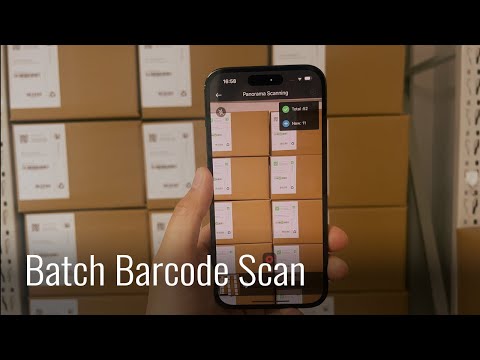
- Industrial-Grade Batch Processing Capabilities: Speed is critical in pathology and diagnostics. Dynamsoft’s decoding architecture is optimized for high-volume batch workflows, ensuring that barcode scanning does not become a bottleneck as throughput scales.
- Robustness for Real-World Laboratory Samples: Laboratory samples are frequently imperfect, obscured by condensation, distorted by curved vial surfaces, or partially damaged during transport. Dynamsoft’s advanced image preprocessing algorithms dynamically adjust contrast, binarization, and sharpness in real time to ensure successful reads on the first attempt, even at 45-degree angles where standard engines fail.
- Enterprise-Grade Precision and Configurability: Dynamsoft Barcode Reader SDK provides more than 100 configuration parameters. Developers can fine-tune the Region of Interest to exclude irrelevant image regions and implement early-exit strategies. Once the barcode is successfully decoded on the first attempt, the system proceeds to the next task without delay.
Proven Impact: Sakura Finetek Pathology Workflow
The operational impact of sub-second, batch barcode decoding can be observed in pathology laboratory workflows where throughput, accuracy, and traceability are critical.
In a Sakura Finetek pathology environment, our solution scanned up to 150 misaligned DataMatrix codes in approximately 20 seconds with greater than 99.9 percent accuracy. This capability enabled automated cassette identification, duplicate and miss detection, and panoramic visualization for audit and correction.
The transition from manual cassette identification to optimized batch barcode decoding produced measurable workflow improvements:
| Metric | Legacy/Manual Process | Dynamsoft-Enabled Batch Scanning | Observed Impact |
|---|---|---|---|
| Scan Time | Manual, tray-by-tray identification | 150 cassettes scanned in ~20 seconds | Reduced per-batch processing time |
| Accuracy | Error-prone visual identification | >99.9 percent DataMatrix read rate | Improved identification reliability |
| Throughput | Limited by manual handling | Scalable batch processing | Increased daily cassette handling capacity |
| Error Handling | Manual checks for misses and duplicates | Automated detection of unreadable and duplicate codes | Reduced rework and exception handling |
| Workflow Visibility | No persistent visual record | Panoramic image view with presence and timestamp | Improved traceability and compliance support |
| System Integration | Fragmented or manual processes | LIS-ready barcode and cassette metadata output | Streamlined downstream processing |
Conclusion: Engineering Laboratory Systems for Millisecond-Level Performance
In a system that processes one sample per second, reducing processing time by 100 milliseconds increases throughput by 10%. At scale, such improvements establish a significant competitive advantage.
Millisecond-level barcode performance has become essential. It is a critical determinant of return on investment, reliability, and scalability in high-throughput laboratory automation. As laboratories transition to higher volumes and greater integration, the most advanced systems will be distinguished not only by mechanical efficiency but also by the speed and intelligence of their software.
Key Takeaways
-
The Millisecond Leak: Efficiency isn’t lost in hours; it’s lost 100ms at a time. If your software takes 500ms to decode, your hardware is just expensive scenery.
-
Stop-and-Go is a Choice: Most labs pause for scans because their software is too slow. Sub-50ms decoding allows for continuous motion, increasing throughput by 10% instantly.
-
The Sakura Standard: 150 cassettes. 20 seconds. 99.9% accuracy. That is the ROI of high-performance decoding.