


 Blog
Blog
From Aerospace to Automotive: Why DPM Barcodes Are the Future of Parts Tracking
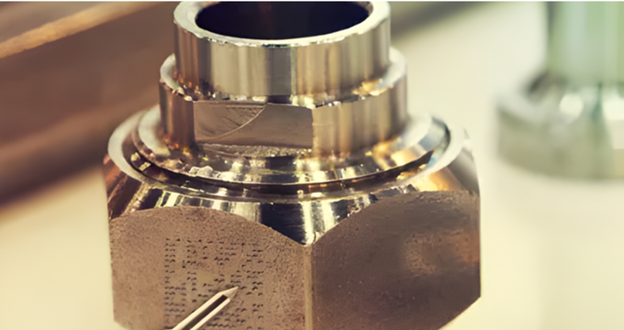
From aircraft engines to automotive assembly lines, manufacturers are under growing pressure to track every part with absolute accuracy throughout its entire lifecycle. Traditional paper labels or printed barcodes often fail in harsh industrial environments, where they are exposed to heat, abrasion, chemicals, and the passage of time.
As products grow more complex and supply chains expand globally, manufacturers are shifting from adhesive labels to Direct Part Marking (DPM). DPM uses technologies such as laser etching, dot peening, or chemical marking to permanently apply machine-readable codes to parts, ensuring their identity remains legible throughout their operational life.
This shift is driven by regulatory pressure, rising recall and counterfeiting costs, and advances in scanning technology. These factors establish DPM as the standard for industrial traceability.
Why Aerospace Adopted DPM First
DPM originated in the aerospace industry, where components often remain in service for decades and undergo multiple maintenance, repair, and overhaul (MRO) cycles. In these environments, labels can burn, peel, or wear away, breaking the digital record of a part’s origin and service history.
By marking identifiers directly onto components, DPM makes identity intrinsic to each part. This allows aerospace operators to track batch numbers, maintenance history, installation/removal events, or compliance documentation.
NASA and major aerospace suppliers have long advocated for permanent identification for lifecycle traceability, while standards such as SAE AS9132 define quality requirements for Data Matrix codes marked directly on parts.
The Automotive Industry is Catching Up
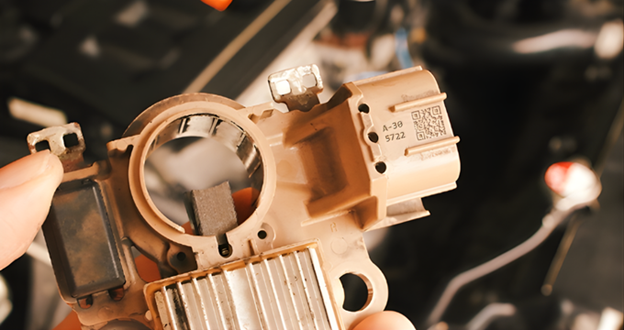
What began in aerospace is now becoming essential in automotive manufacturing. Modern vehicles contain thousands of parts sourced from global suppliers. As a result, automakers face growing pressure to maintain end-to-end supply chain visibility, ensure recall readiness, and meet stricter quality standards.
Electric Vehicles (EVs) have sped up this change. High-voltage batteries, power electronics, and other safety parts now face stricter rules and safety checks. Accurate part-level traceability is needed to find affected battery cells or modules during safety checks and recalls.
Why Direct Part Marking (DPM) Is Ideal for Industrial Parts Tracking
Permanent Traceability Across the Entire Product Lifecycle
DPM barcodes last as long as the part itself, making them ideal for long-lifecycle aerospace, automotive, and industrial components.
Reliable Performance in Harsh Manufacturing Environments
DPM codes remain readable despite exposure to heat, vibration, corrosion, abrasion, and repeated cleaning.
Improved Quality Control and Recall Management
Manufacturers can trace defects back to a specific batch, supplier, or production step—reducing recall scope, downtime, and cost.
Seamless Integration with Automation and MES Systems
DPM barcodes integrate with automated inspection systems, robotics, and Manufacturing Execution Systems (MES), enabling real-time traceability.
High Data Density with Data Matrix Codes
DPM commonly uses Data Matrix codes, which store serial numbers, batch IDs, and manufacturing data in a compact footprint—even on very small components.
How Modern Barcode Scanning Software Enables Reliable DPM Decoding
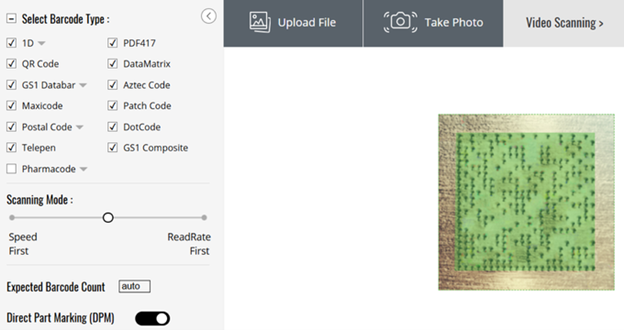
Recent advances in image processing have significantly accelerated DPM adoption. While decoding low-contrast or distorted marks once required specialized fixed-mount cameras, modern barcode scanner SDKs now enable reliable DPM decoding on mobile devices and industrial systems.
These SDKs use techniques such as edge detection, contrast enhancement, geometric reconstruction, and noise filtering to read DPM codes on curved, worn, or contaminated surfaces.
As a result, manufacturers no longer need to rely solely on hardware upgrades. By enhancing the software layer, they can achieve reliable DPM scanning with existing devices and workflows.
Our solution, Dynamsoft Barcode Reader SDK, is built specifically for industrial and enterprise environments and supports:
- Data Matrix and DPM decoding for direct part marks on metal, plastic, and other challenging surfaces,
- Low-contrast and dot-peen mark reading, where conventional scanners often fail, Offline scanning for factory floors, ensuring continuous traceability even without network connectivity,
- Integration with industrial cameras and mobile devices, enabling scanning on rugged handhelds, embedded systems, or vision-based inspection stations.
Adding advanced decoding to current devices and workflows allows companies to achieve reliable, company-wide traceability without needing major new hardware investments.
How Direct Part Marking Reduces Global Supply Chain Risk

The demand for reliable identification is also driven by the risk of counterfeiting. According to the OECD and EUIPO, global trade in counterfeit and pirated goods was valued at approximately USD 467 billion in 2021, posing a significant threat to industrial supply chains.
DPM addresses this risk by providing a permanent, machine-readable identity on each part. Unlike labels or packaging-based identifiers, DPM codes remain with the component throughout its lifecycle, making it much more difficult for illegitimate or unverified parts to enter regulated manufacturing and service environments.
Powering Real-World DPM Traceability with Dynamsoft
Direct Part Marking enables permanent, machine-readable identification for modern manufacturing. But real-world conditions make DPM scanning difficult. Common challenges include:
- Low contrast on metal surfaces
- Small, damaged, or distorted codes
- Dirt, oil, and harsh environments
Dynamsoft Barcode Reader (DBR) is designed for these realities, offering:
- DPM-optimized Data Matrix decoding
- Advanced image processing for low-quality marks
- Integration with mobile devices and industrial cameras
With the right software, permanent marks become reliable, actionable data throughout the entire lifecycle.