


Free
Trial
Barcode Types
The Dynamsoft Barcode Reader SDK is designed to recognize different types of barcodes, including linear barcodes, 2-dimensional barcodes such as QR Code, PDF417, DataMatrix, MaxiCode, and Aztec Code, DataBar, GS1 Composite symbologies, Pharmacode, Patch Code, and various types of postal codes.
Compare Different Barcode Types >
Supported Linear Barcode Symbologies
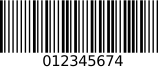
1D Retail


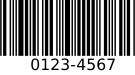
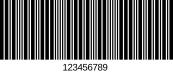
1D Industrial
Others

Supported 2D Barcode Symbologies













1D Barcode Symbologies
Universal Product Code
The Universal Product Code (UPC) is a barcode system widely used in the retail industry for tracking and identifying products. It is a crucial component of point-of-sale (POS) systems and plays a significant role in inventory management and supply chain operations. The UPC system includes various formats, each designed to cater to different product sizes and packaging constraints. These formats include:
UPC-A
UPC-E
EAN-13
EAN-8
Two-out-of-five code
Code 2 of 5, also known as 2 of 5, is a family of barcode symbologies that encode numeric data through variations in bar widths. Within this family, Industrial 2 of 5 and Interleaved 2 of 5 (ITF) are two notable formats.
Industrial 2 of 5 is an older format that encodes data using two wide bars and three narrow ones out of five total bars, hence the name "2 of 5." This symbology has largely been phased out in favor of more efficient and secure formats.
Interleaved 2 of 5 (ITF) is a high-density barcode that evolved from Industrial 2 of 5. It encodes data in pairs of digits, with the first digit represented by the five bars (black lines) and the second digit by the five spaces (white lines) interleaved between them. This format is particularly useful in logistics and industrial applications where space is limited and a compact, efficient encoding of numeric data is required.
Code Family
Code 11: Code 11 is a linear, numeric barcode symbology commonly used in telecommunications equipment labeling.
Code 39: Code 39 is a variable-length barcode symbology. Widely employed in inventory and shipping applications, it is the first barcode type to use both numbers and letters.
Code 93: Code 93 barcode is a high-density symbology that can fit more characters in a smaller space, making it great for compact labels.
Code 128: Code 128 barcode symbology is widely used in industries and stores. It includes letters (upper and lower case), numbers, and standard ASCII symbols to encode information.
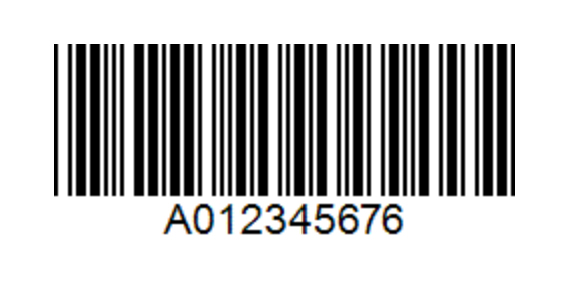
Others
Codabar: Codabar is a self-checking, numeric-only barcode symbology, designed for simplicity. It is commonly used in libraries, blood banks, and for inventory control.
MSI Code: MSI Code, also known as Modified Plessey, is commonly utilized in inventory and tracking applications. It employs a binary encoding scheme for efficient representation of numeric data, making it suitable for diverse industrial and retail environments.
GS1 DataBar
The GS1 DataBar family comprises seven barcode types designed for various retail and inventory management needs. These include:
GS1 DataBar Omnidirectional - GS1 DataBar Omnidirectional
GS1 DataBar Truncated - GS1 DataBar Truncated
GS1 DataBar Stacked - GS1 DataBar Stacked
GS1 DataBar Stacked Omnidirectional - GS1 DataBar Stacked Omnidirectional
GS1 DataBar Limited - GS1 DataBar Limited
GS1 DataBar Expanded - GS1 DataBar Expanded
GS1 DataBar Expanded Stacked - GS1 DataBar Expanded Stacked
In the retail industry, the choice between UPC and GS1 DataBar (or any other barcode type) depends on several factors:
-
Product Size: For smaller items where a UPC barcode may not fit, the GS1 DataBar, especially in its truncated or stacked forms, might be a better choice due to its compact size.
-
Information Requirements: If additional product information, such as weight, expiration date, or batch number, needs to be encoded, the GS1 DataBar Expanded versions would be more suitable than the UPC.
-
Scanning Efficiency: For products that require fast and omnidirectional scanning, such as in high-volume retail environments, the GS1 DataBar Omnidirectional or Stacked Omnidirectional types might be preferred.
-
Global Compatibility: While the UPC is widely used in North America, the GS1 DataBar is part of a global standard and might be chosen for products that are distributed internationally.
-
Industry Standards: Certain industries or product categories might have specific standards or preferences for barcode types. For example, fresh produce is increasingly using GS1 DataBar for better traceability.
2D Barcode Symbologies
QR Code:
QR (Quick Response) code, a widely used 2-dimensional barcode, features black squares on a white background in a grid, readable by cameras, scanners, or imaging devices.
Micro QR Code:
Micro QR Code is a compact version of QR Code, which is ideal for limited space or data needs. Like QR Codes, it can encode Kanji characters.
PDF417:
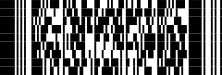
PDF417, a common 2D barcode, is stacked, variable-length, and bidirectional. Widely used in logistics, transportation, government ID, inventory, and document management.
Micro PDF417:
Micro PDF417, derived from PDF417, is a variable-length stacked 2D barcode, capable of encoding moderate data compactly.
Data Matrix:
Data Matrix is a compact 2D barcode consisting of black and white cells arranged in a 'square' manner. Common use cases involve labeling small electronic and industrial parts.
Aztec:
Aztec code is a multi-purpose 2D barcode popular in airline tickets and travel documents.
MaxiCode:
MaxiCode is a 2D barcode developed and used by the UPS. It consists of hexagonal modules with concentric circles at the center.
DotCode:
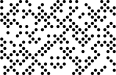
DotCode is a 2-dimensional barcode designed for high-speed, high-volume printing applications, utilizing a matrix of dots arranged in a grid format to encode data, offering excellent readability and reliability.
Composite Symbologies
GS1 Composite Code:
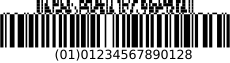
GS1 Composite Code is a combination of a 1D component (for primary information) and a 2D component (for encoding additional information).
USPS Intelligent Mail:
USPS Intelligent Mail is a 65-bar symbology used by the US Postal Service for tracking and sorting letters and cards.
POSTNET:
POSTNET is a barcode type used by the US Postal Services. It was used to improve efficiency and reduce sorting time.
Planet:
Planet is another barcode symbology that was used by US Postal Services to identify the class and shape of letters/mail.
Australian Post:
The Australian Post barcode is a 4-state 1D symbology of variable length (37 to 67 bars). It is used to identify the point to which the mail is to be delivered.
Royal Mail 4-State Customer Code (RM4SCC) or UK Royal Mail:
The Royal Mail 4-State Customer Code was developed by the United Kingdom Postal System for efficient mail sorting and to ensure it reaches its destination.
Patch Code:
Patch Codes are special markers used in document scanning to help scan multiple documents. Patch Codes are often used in conjunction with document scanners to indicate the start or end of a batch of documents.
Pharmacode One-Track:
The Pharmacode One-Track is a basic 1D barcode (encodes numeric data only) consisting of one track of bars. Its main use is to identify and track pharma products.
Pharmacode Two-Track:
The Pharmacode Two-Track is an expanded version of the Pharmacode One-Track, used when larger data is needed for product identification and tracking.